
A field note on drive trips, fan loads, and real-world tuning
VFD auto-tuning is a very useful function.
It helps the drive identify the motor’s electrical characteristics and improve control performance. In many cases, it gives us a good starting point for stable operation.
But there is one important point that field engineers should not forget.
Auto-tuning identifies the motor.
It does not fully understand the application.
This difference becomes especially important when the VFD is controlling a high-inertia load such as a large fan, blower, pump, or rotating machine exposed to changing process conditions.
In the field, the motor is only one part of the system.
The real load includes air flow, duct pressure, mechanical inertia, external disturbance, PID response, acceleration and deceleration behavior, torque limits, current limits, and the protection logic of the drive.
This field note is about a case where a VFD stopped during low-speed operation of a high-inertia fan load. At first, it looked like a drive problem. But after reviewing the alarm history and operating trend, the issue was closer to an application tuning problem than a hardware failure.
The Situation
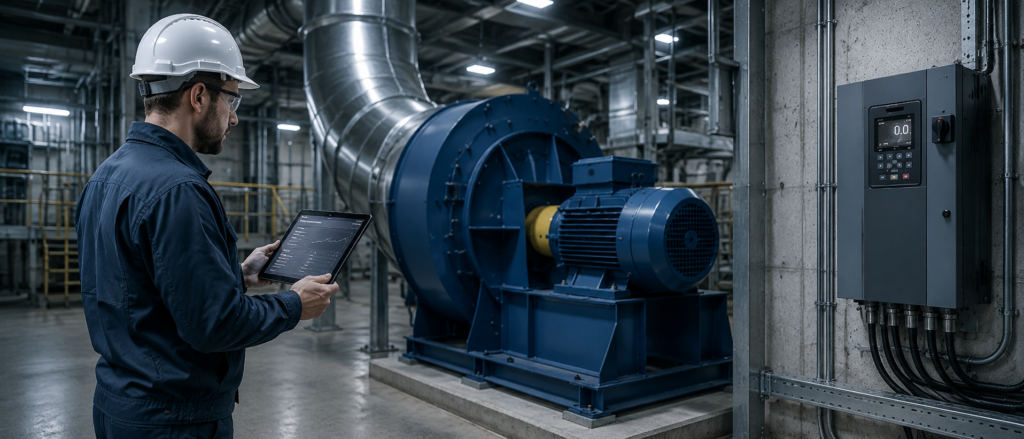
A high-inertia fan was being operated by a VFD.
The system had already been commissioned, and the drive had been running under normal operating conditions. There was no special operation, no obvious mechanical failure, and no intentional change in the load condition.
Then, during low-speed operation, the VFD suddenly generated a warning and stopped.
At first glance, this kind of event can easily lead us to suspect the drive itself.
Was the inverter defective?
Was there a motor problem?
Was the load jammed?
Was the protection setting too sensitive?
Those are natural questions.
Fortunately, operation data and alarm history were available. When the trend was checked, the trip had occurred during low-speed operation. There was also a possibility that a strong external gust of wind or air disturbance had affected the fan at that moment.
This made the case more interesting.
The problem did not look like a simple hardware fault. It looked more like a sudden disturbance in the actual load condition.
What Probably Happened
For fan and blower applications, the mechanical load is not always constant.
Even if the motor speed command stays the same, the actual load torque can change due to air flow, duct pressure, damper position, external wind, process condition, or mechanical resistance.
In this case, the fan was operating at low speed. A sudden external disturbance may have changed the aerodynamic load acting on the fan blades.
Strictly speaking, the fan’s moment of inertia itself does not suddenly change. The rotating mass remains the same.
What changes is the load condition applied to the rotating system.
A sudden change in aerodynamic load can cause the motor current or torque demand to fluctuate sharply. If the VFD detects this as an abnormal condition, it may activate its protection logic and stop the drive.
From the drive’s point of view, the trip may have been a correct protective action.
The drive was not necessarily “wrong.”
It simply responded to a condition that exceeded or disturbed the expected operating range.
That is why this case is important.
Sometimes the VFD is not the problem.
Sometimes the settings are not ready for the real application.
Why Auto-Tuning Was Not Enough
Auto-tuning is often misunderstood.
Many engineers and technicians think that once auto-tuning is completed, the VFD is fully optimized.
But that is not always true.
In most VFDs, motor auto-tuning mainly identifies motor-related parameters such as resistance, inductance, rated current, motor characteristics, and control model data.
That information helps the drive control the motor more accurately.
However, auto-tuning does not fully optimize the entire system.
It does not automatically understand:
- The inertia of a large fan
- Air flow disturbance
- Duct pressure fluctuation
- Low-speed instability
- PID hunting
- Regenerative behavior during deceleration
- External wind conditions
- Seasonal operating changes
- Mechanical aging
- Actual process response
In other words, auto-tuning can tell the VFD a lot about the motor.
But it cannot completely tell the VFD how the real plant behaves.
That part still requires application tuning.
The Key Difference: Motor Tuning vs. Application Tuning
This distinction is important.
Motor tuning focuses on the motor itself.
It answers questions such as:
- What are the motor parameters?
- How should the drive control the motor electrically?
- How can the drive estimate motor behavior more accurately?
Application tuning focuses on the actual system.
It answers questions such as:
- How fast should the fan accelerate?
- How slowly should it decelerate?
- How much torque margin is required?
- Is the current limit too low?
- Is the PID response too aggressive?
- Is the load exposed to external disturbance?
- Is low-speed operation stable?
- Is the protection logic suitable for the real process?
A VFD may be perfectly tuned for the motor and still be poorly tuned for the application.
That is the point of this case.
What Was Checked and Adjusted
After reviewing the alarm log and operating trend, the event did not appear to be caused by an inverter hardware failure.
The stop looked like a protective response caused by an abnormal operating condition.
So the focus shifted from “replace the drive” to “review the application settings.”
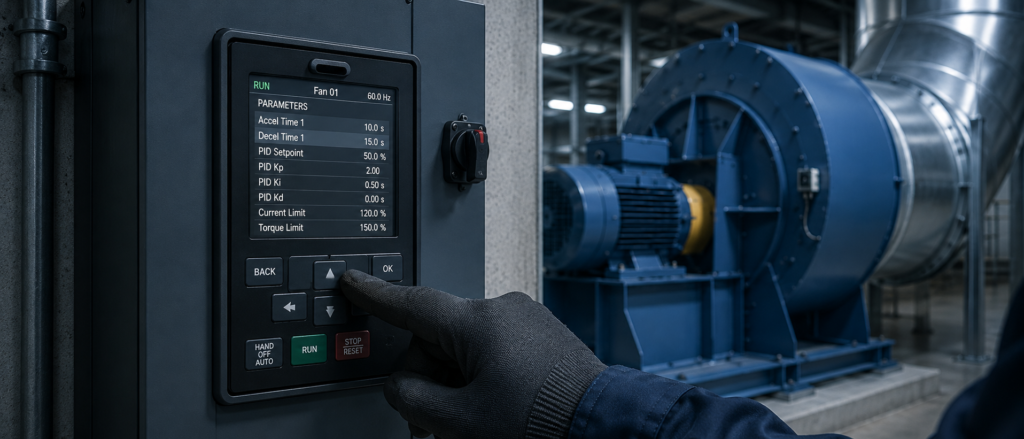
The following items were checked and adjusted.
1. Auto-Tuning Was Performed Again
The motor auto-tuning was performed again to make sure the basic motor model inside the drive was correct.
This was not the final solution by itself, but it was a necessary starting point.
If the motor data inside the drive is inaccurate, all other control behavior can become unstable.
2. Acceleration and Deceleration Time Were Reviewed
For high-inertia loads, acceleration and deceleration time are critical.
A large fan cannot be treated like a small motor with a light load.
If the deceleration time is too short, the rotating inertia may cause regenerative energy or current fluctuation. If the acceleration time is too aggressive, the motor may demand excessive torque.
In this case, the deceleration time was especially important.
The setting was adjusted to reduce sudden current fluctuation and allow the system to respond more smoothly.
3. PID Parameters Were Adjusted
The PID control response was also reviewed.
If the PID gain is too sensitive, a small disturbance can create an excessive control reaction.
For a fan or blower system, this can result in speed hunting, torque fluctuation, unstable current, or unnecessary trips.
In the field, “fast response” is not always the best response.
For large rotating equipment, a slightly slower and more stable response is often better than an aggressive response that creates instability.
4. Current and Torque Limits Were Reviewed
Current limit and torque limit settings are protection tools.
But if they are set too low, the VFD may trip during normal process disturbance.
If they are set too high, the drive may fail to protect the motor and equipment when a real fault occurs.
The correct setting must balance two things:
- Protection of the equipment
- Tolerance for normal process disturbance
In this case, the limits were reviewed and adjusted so that the drive could handle sudden but acceptable load variation without unnecessary shutdown.
Why Low-Speed Fan Operation Can Be Sensitive
Low-speed operation can be more sensitive than many people expect.
At low speed, the fan may have less operating margin. The air flow may be unstable. External disturbance may have a stronger relative effect on the fan behavior.
For high-inertia fan and blower loads, low-speed operation is not always “easy operation.”
It can be one of the most delicate operating regions.
This is especially true when the system is exposed to:
- Wind
- Reverse air flow
- Duct pressure fluctuation
- Damper movement
- Process instability
- Aggressive PID control
- Mechanical looseness
- Aging bearings or fan components
That is why VFD settings should be reviewed under real operating conditions, not only during initial commissioning.
The Protection Logic Is Both a Friend and a Risk
A VFD’s protection logic exists to protect the system.
It protects the motor, drive, cable, mechanical equipment, and sometimes the process itself.
But protection settings are not simply “good” or “bad.”
If the protection is too sensitive, the system may suffer from nuisance trips.
If the protection is too relaxed, the system may not stop when a real fault occurs.
The goal is not to disable protection.
The goal is to make protection appropriate for the application.
For a high-inertia fan load, this means the engineer should understand both the electrical behavior and the mechanical behavior of the system.
A trip is not just an alarm code.
A trip is a message from the system.
The job of the field engineer is to understand what that message really means.
Practical Checklist for Similar VFD Fan Applications
If you are operating a VFD-driven fan or blower, especially a high-inertia load, it may be worth checking the following items.
Motor and Drive
- Is the motor nameplate data correctly entered?
- Was auto-tuning performed correctly?
- Is the selected control mode suitable for the application?
- Is the VFD capacity appropriate for the load?
Acceleration and Deceleration
- Is the acceleration time too short?
- Is the deceleration time too short?
- Is regenerative behavior properly handled?
- Is there a braking resistor or DC bus overvoltage issue?
PID Control
- Is the PID gain too aggressive?
- Is the system hunting at low speed?
- Is the process response slower than the control response?
- Is the feedback signal stable?
Protection Settings
- Are current and torque limits too low?
- Are overload settings appropriate?
- Are trip conditions understood?
- Are protection settings based on actual operation data?
Field Conditions
- Is the fan exposed to external wind or reverse flow?
- Does duct pressure fluctuate?
- Are dampers operating properly?
- Has the process condition changed since commissioning?
- Are there seasonal changes that affect operation?
Field Lesson
The biggest lesson from this case is simple.
VFD auto-tuning is only the beginning.
It is not the final answer.
Auto-tuning helps the drive understand the motor, but reliable operation depends on tuning the drive for the real application.
In the field, settings should not be treated as fixed numbers that never change.
A setting that worked during commissioning may not be the best setting after process conditions change. A fan that ran well during normal weather may behave differently when exposed to strong wind or pressure fluctuation. A PID setting that looks fast and responsive may become unstable under real disturbance.
Good VFD tuning is not just parameter input.
It is a feedback process.
Observe the system.
Check the trend.
Understand the load.
Adjust the parameters.
Test again.
Keep learning from the field.
That is how we move from “the drive is running” to “the system is reliable.”
Final Thought
When a VFD trips, it is tempting to blame the drive first.
But sometimes the drive is simply doing its job.
The better question is this:
Do our settings really reflect the actual field conditions?
For high-inertia fan loads, this question matters.
Because in the real world, the motor does not run alone.
It runs with air, pressure, inertia, disturbance, control logic, protection settings, and the unpredictable behavior of the plant.
That is why VFD tuning should not stop at auto-tuning.
Auto-tuning identifies the motor.
Application tuning makes it work in the real world.