

While reviewing a centrifugal pump datasheet and performance curve, I noticed something that made me stop for a moment.
The pump BHP was quite close to the selected motor HP.
At first, this may look like a mechanical engineering issue.
A pump datasheet belongs to the mechanical discipline.
A pump performance curve is usually reviewed by the pump vendor or rotating equipment engineer.
And as an electrical engineer, it is easy to think:
“The motor HP is already specified. My job starts from there.”
But in practice, that boundary is not always so clean.
Because the motor size does not exist by itself.
It comes from the mechanical load.
And once the motor size changes, the impact can quickly spread into the electrical system.
That is why I think electrical engineers should have at least some interest in the pump data that determines motor loading.
Not to design the pump.
Not to replace the mechanical engineer.
But to understand the interface.
The Number That Connects the Pump to the Electrical System

For an electrical engineer, one of the most important numbers on a pump datasheet is BHP.
BHP represents the mechanical power required by the pump at the shaft.
The motor has to provide that power.
So even if most of the pump datasheet is outside my discipline, the relationship between:
Pump BHP → Motor HP
is directly relevant to electrical design.
When the difference between the required pump power and the selected motor rating looks small, I become interested.
Not because a small difference automatically means the motor is undersized.
It may be perfectly acceptable depending on the design criteria.
But it is enough to make me ask:
Does this motor really have enough margin for the expected operating range?
That question is worth asking before the equipment is purchased and installed.
Rated BHP Is Not Always the Whole Story
Another thing I try to look at is whether the pump curve shows a higher power requirement away from the rated point.
The pump may have one BHP value at the rated condition.
But the actual motor has to support the pump through the intended operating range.
If the required shaft power increases as the operating point moves, the motor margin can become smaller than it first appeared on the datasheet.
This does not mean the electrical engineer needs to analyze pump hydraulics in detail.
The responsibility for pump selection still belongs to the appropriate engineering discipline and vendor.
But the electrical engineer can still ask a simple question:
“What is the maximum power this pump is expected to require, and how does that compare with the selected motor?”
That question is directly related to our own scope.
I Have Seen What Happens When the Margin Is Too Small
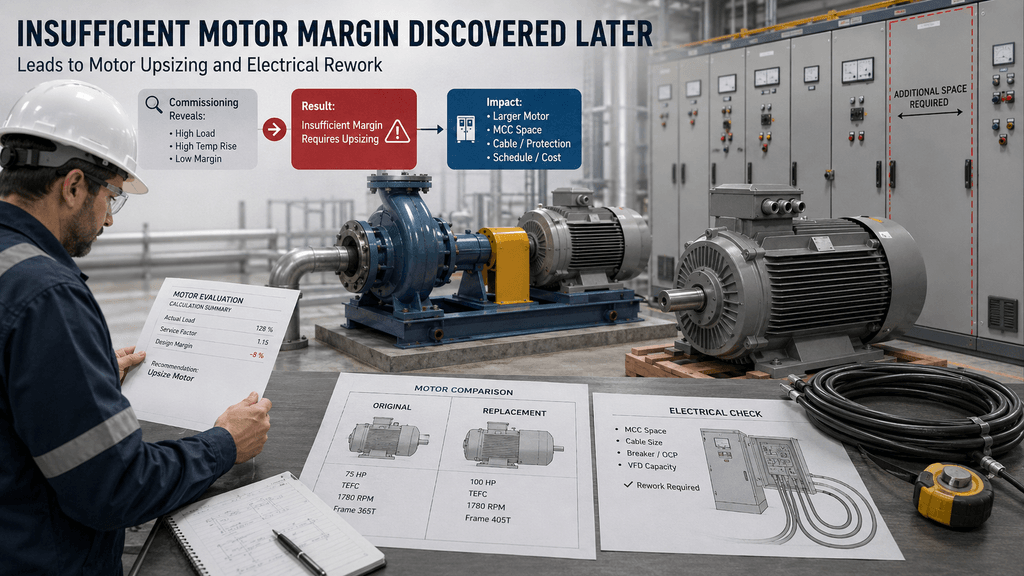
This is not just a theoretical concern.
I have experienced cases where the original motor selection did not provide enough usable margin for the actual operating requirement.
The issue was not that the motor suddenly became defective.
The motor simply reached a point where the pump could not be operated at the required condition without pushing the motor too close to its loading limit.
Eventually, the motor had to be upsized.
At that point, what looked like a pump-side problem became an electrical modification project.
The motor rating changed.
Then the cable had to be reviewed.
The breaker had to be reviewed.
The starter or contactor had to be reviewed.
The overload protection had to be reviewed.
The MCC feeder capacity had to be reviewed.
Depending on the installation, upstream equipment may also need another look.
That is when a relatively small design issue becomes expensive.
Changing a motor on paper is easy.
Changing a motor after the cable has been installed and the MCC has already been built is a very different problem.
This Is Why Interface Review Matters
Electrical engineers naturally spend most of their time on electrical documents.
Single-line diagrams.
Load lists.
Motor lists.
Cable schedules.
MCC drawings.
Protection settings.
Those are our main responsibility.
But many electrical design decisions originate outside the electrical discipline.
A process condition determines the pump duty.
The pump duty determines the pump selection.
The pump selection determines the required shaft power.
And that required shaft power becomes the basis for the motor rating.
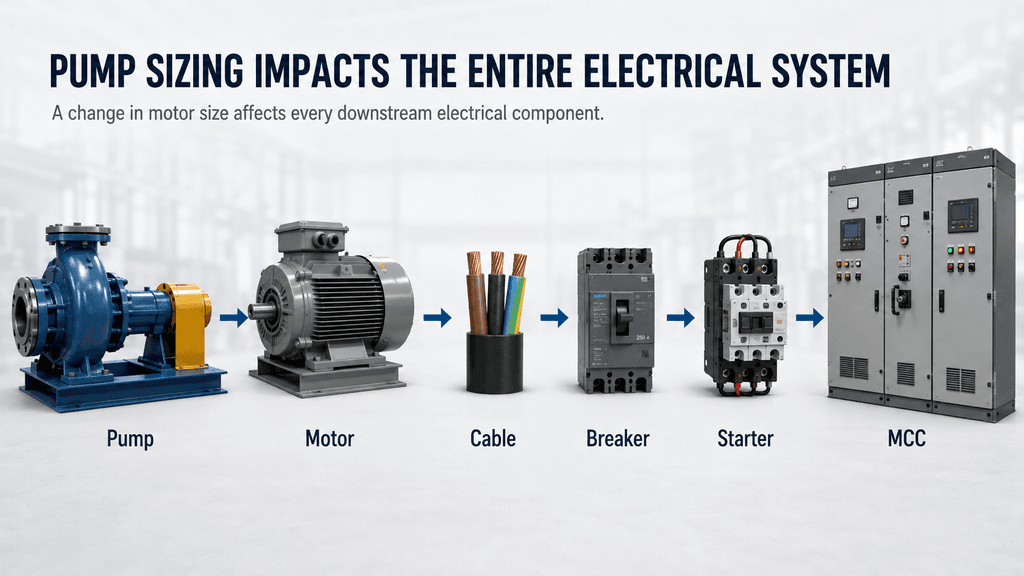
From there, the motor rating affects:
Motor → Cable → Breaker → Starter → MCC → Upstream system
So if we only look at the final motor HP written on the motor list, we may miss an opportunity to catch a problem earlier.
Sometimes one number on a mechanical datasheet can eventually affect an entire electrical feeder.
What I Actually Check
I do not try to review the entire pump design.
I mainly check the information that connects directly to the electrical system.
1. Pump BHP at the rated point
First, I compare the required pump power with the selected motor rating.
If the values are unusually close, I want to understand the selection basis.
2. Maximum BHP shown on the performance curve
If a power curve is available, I look at whether the required power becomes higher elsewhere in the intended operating range.
The important question is not only:
“Does the motor cover the rated point?”
It is also:
“Does the motor cover the expected operating range?”
3. Selected motor rating
I check whether the motor rating shown on the motor list, datasheet, and vendor documents is consistent.
Again, I am not deciding what the pump needs.
I am checking whether the electrical equipment being designed around that motor has a sound basis.
4. What happens if the motor needs to be larger?
This is probably the most electrical question of all.
If the motor needs to move up one rating, what else changes?
Will the existing cable still be acceptable?
Is the breaker rating sufficient?
Is the starter or contactor adequate?
Does the MCC feeder have enough capacity?
Can the existing equipment physically accommodate the larger motor feeder?
These questions are much easier to answer during design review than after commissioning.
You Do Not Need to Own the Other Discipline
There is always a risk when engineers start looking outside their own discipline.
We should not overstep responsibility.
An electrical engineer does not need to become a pump specialist.
And we should not make mechanical design decisions without the responsible engineer or vendor.
But there is a big difference between:
doing someone else’s design
and
understanding how their design affects yours.

The second one is part of good engineering.
In real projects, problems often appear at the boundaries between disciplines.
Mechanical and electrical.
Process and electrical.
Civil and electrical.
Control and electrical.
Each discipline may complete its own calculation correctly, but the final system can still have a problem if the interface is not reviewed carefully.
That is why I think engineers become more useful to an organization when they occasionally look one document beyond their own scope.
A Small Question Can Prevent a Large Modification
When I see pump BHP very close to motor HP now, I do not immediately say the motor is wrong.
I simply ask one more question.
“Is this motor selection still adequate across the required operating range?”
If the answer is yes, good.
Nothing more needs to happen.
But if that question reveals a problem before procurement, fabrication, or installation, the value of that small review can be significant.
Because by the time the motor needs to be upsized in the field, it may no longer be just a motor problem.
It can become a cable problem.
A breaker problem.
An MCC problem.
And eventually a project cost and schedule problem.
I do not need to design the pump.
But I should understand the number that determines my motor size.
Sometimes that is enough.
Field Checklist
When reviewing a centrifugal pump package:
□ Check pump BHP at the rated operating point
□ Check maximum BHP shown on the pump performance curve
□ Compare pump BHP with the selected motor HP
□ Ask for clarification if the available motor margin looks unusually small
□ Confirm the motor rating is consistent across the relevant project documents
□ Consider the cable, breaker, starter, and MCC impact if the motor rating changes
□ Raise the question before procurement or installation, not after commissioning
Safety Note:
Pump and motor selection should follow the approved project specifications, vendor recommendations, applicable standards, and the design basis established by the responsible engineering disciplines. Electrical engineers should use pump data to review electrical interfaces, not to replace the responsible pump or process engineering review.