

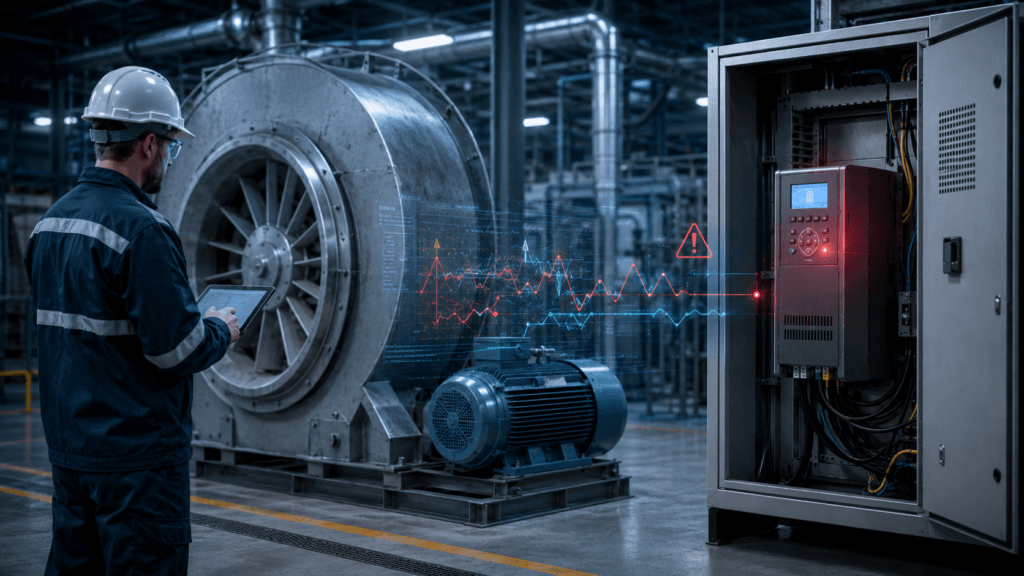
A field note on fan loads, nuisance trips, and choosing the right control mode
Modern VFDs are powerful.
They offer advanced motor control modes, better torque response, improved speed regulation, automatic tuning, motor model estimation, and many useful protection functions.
Because of that, it is easy to assume one thing:
The more advanced the control mode, the better the result.
But in the field, this is not always true.
Sometimes the best setting is not the most advanced one.
Sometimes the best setting is the one that makes the equipment run reliably under real operating conditions.
This field note is about a repeated VFD fault on a high-inertia fan load. After checking the motor, mechanical condition, electrical supply, and drive status, I eventually changed the control mode from Sensorless Vector Control to V/F Control.
The result was simple.
The fan became more stable.
The Situation
The equipment was a fan-driven system controlled by a VFD.
The drive had been set to Sensorless Vector Control. On paper, this looked like a reasonable choice. Sensorless vector control can provide better low-speed torque and better speed regulation compared with basic V/F control.
So, at first, the setting did not look suspicious.
But the problem was that the VFD kept stopping during operation.
The difficult part was that the trip was not clearly explained by a typical fault category.
It was not an obvious overcurrent fault.
It was not a clear overload fault.
It was not a ground fault.
It was not a clear overvoltage event.
The drive stopped by its own protection logic, but the alarm information did not point to one clean root cause.
This is one of the most frustrating situations in field maintenance.
The equipment stops.
The alarm log is not clear.
The motor looks normal.
The drive does not appear to be damaged.
The mechanical side does not show an obvious problem.
But the system still stops.
First Checks: Looking for a Hardware Problem
The first step was to check the basic items.
Before blaming the control mode, it was necessary to confirm that there was no obvious physical problem.
The following items were reviewed:
- Motor insulation condition
- Bearing condition
- Mechanical interference
- Fan vibration and abnormal noise
- Load-side restriction or rubbing
- VFD internal temperature
- Cooling condition of the drive
- Input voltage stability
- Output current behavior
- Current response during acceleration and deceleration
Nothing critical was found.
The motor did not show a clear insulation problem.
There was no obvious mechanical binding.
The drive did not show signs of internal overheating.
The current waveform did not immediately suggest a serious electrical fault.
That made the problem more interesting.
If the motor was acceptable, the mechanical condition was acceptable, and the VFD hardware looked normal, then the question became different.
Maybe the problem was not the equipment.
Maybe the problem was how the VFD was trying to control the equipment.

Changing the Question
At first, my question was:
“Why is the VFD stopping?”
But after the initial checks, the better question became:
“Is the selected control mode suitable for this specific load?”
That shift was important.
Sensorless Vector Control is not magic. It does not directly measure the motor shaft speed with an encoder. Instead, it estimates motor behavior using voltage, current, motor parameters, and an internal motor model.
That estimation can work very well when the motor data is accurate and the operating condition is suitable.
But a fan system is not always a clean and predictable load.
A high-inertia fan can be affected by:
- Airflow disturbance
- Duct pressure fluctuation
- Reverse flow
- Damper position
- External wind
- Low-speed instability
- Process condition changes
- Large rotating inertia
In such a system, the VFD may see a difference between what its internal model expects and how the motor-load system actually responds.
When that mismatch becomes large enough, the drive may interpret the condition as abnormal.
Then the protection logic may intervene.
From the drive’s point of view, it is not necessarily making a mistake.
It is protecting the system based on its control logic and internal estimation.
But from the plant’s point of view, the result is still a problem.
The equipment stops.
The Experiment: Sensorless Vector to V/F Control
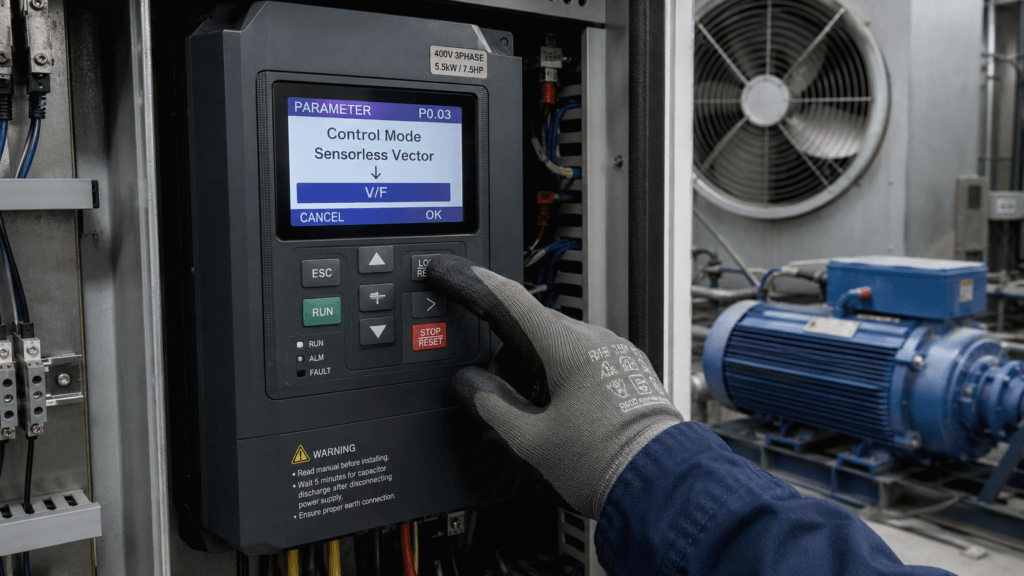
After checking the hardware and reviewing the operating behavior, I decided to make one simple change.
I changed the control mode from:
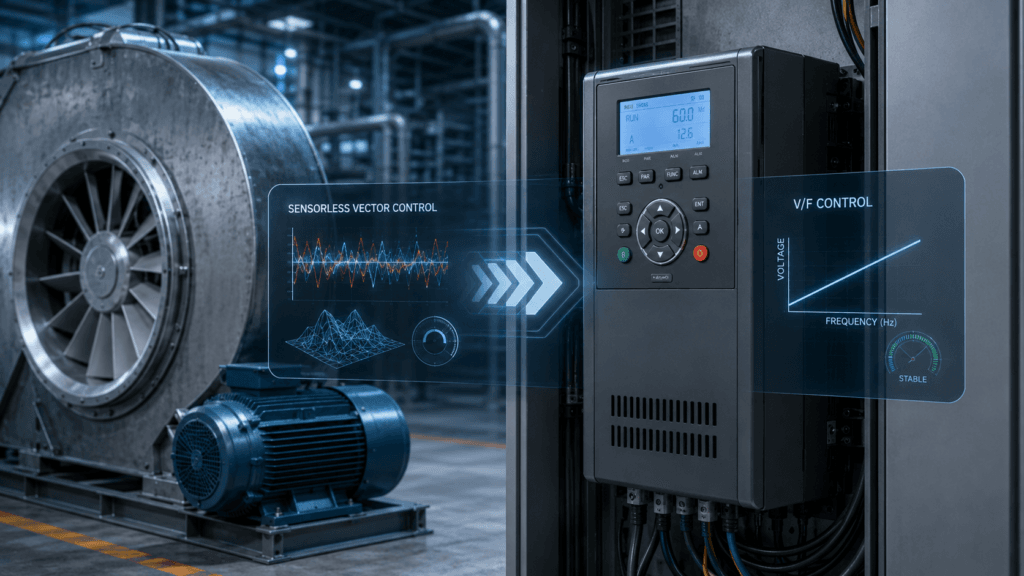
Sensorless Vector Control
to:
V/F Control
Other settings were kept as close as possible to the original condition.
The purpose was not to randomly change parameters.
The purpose was to test one hypothesis:
Maybe the advanced control mode was too sensitive for this application.
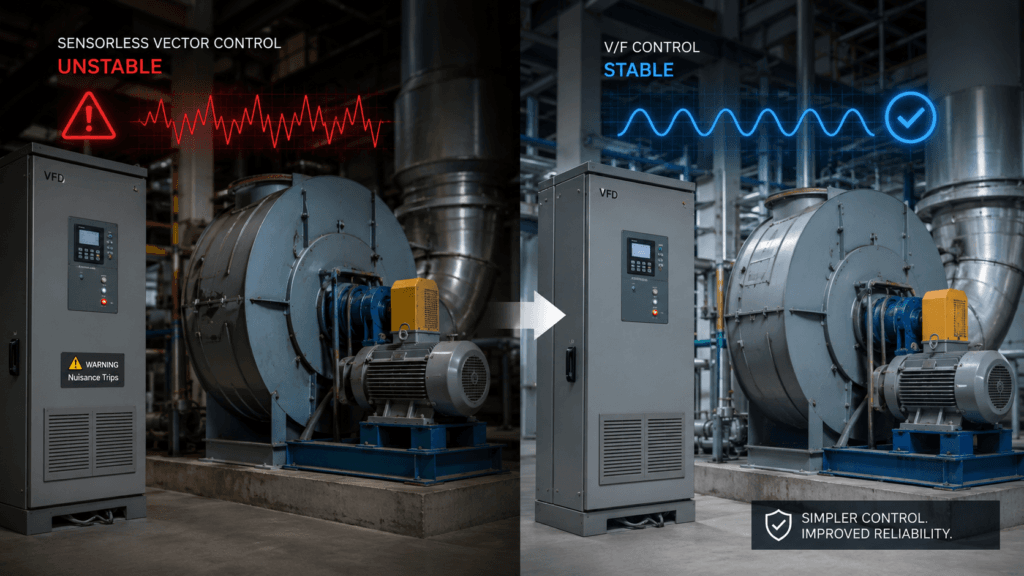
After changing to V/F Control, the result was clear.
Under similar operating conditions, with the same load and similar disturbance environment, the fan operated without repeated trips.
The current may have looked slightly higher, but the drive did not stop.
That was an important result.
It suggested that the issue was not a simple hardware defect.
It was more likely related to control mode selection and how the VFD interpreted the real behavior of the fan load.
Why V/F Control Worked Better in This Case
V/F Control is simple.
It controls the motor by maintaining a relationship between voltage and frequency.
It does not rely on the same level of internal motor-state estimation as sensorless vector control.
Because of that, it may not provide the same torque performance or speed regulation in demanding applications.
But simplicity can also be a strength.
For a fan application that does not require highly precise speed control, V/F Control can be more tolerant of load disturbance.
It does not try to interpret every small deviation through a more complex motor model.
It simply keeps the motor running according to the commanded frequency and voltage pattern.
In this case, that simpler behavior was more suitable for the field condition.
The application did not need high dynamic torque response.
It did not need precision positioning.
It did not need tight speed regulation.
It needed stable continuous operation.
For that requirement, V/F Control was enough.
More importantly, it was more reliable.
Sensorless Vector Control Is Not Wrong
This point is important.
The lesson is not that Sensorless Vector Control is bad.
Sensorless vector control has clear advantages.
It can be useful when the application requires:
- Better low-speed torque
- Improved speed regulation
- Faster torque response
- More accurate motor control
- Better performance under varying load
- Higher control quality without an encoder
For many applications, it is the better choice.
The problem is not the control method itself.
The problem is using an advanced control method without asking whether the application really needs it.
A high-inertia fan is not the same as a conveyor, hoist, extruder, winder, or precision machine.
Each load has a different control requirement.
The best VFD setting depends on the purpose of operation.
If the priority is precision, vector control may be better.
If the priority is stable continuous operation under a simple fan load, V/F Control may be enough.
In some cases, it may even be better.
The Real Lesson: Advanced Does Not Always Mean Better
This case reminded me of a simple field lesson.
Advanced control is not always better control.
Better control means suitable control.
A setting can be technically advanced and still be wrong for the application.
A setting can be old and simple and still be the most reliable option.
In plant maintenance, the goal is not to use the most sophisticated parameter.
The goal is to make the equipment run safely, reliably, and predictably.
That means we should select VFD settings based on the actual field condition, not only based on the theoretical advantage of a control mode.
The important questions are:
- What kind of load is this?
- Does the process need precision control?
- Is low-speed torque important?
- Is the load exposed to disturbance?
- Is the system sensitive to nuisance trips?
- Is continuous operation more important than tight speed regulation?
- Does the selected control mode match the real operating condition?
These questions matter more than simply choosing the newest or most advanced control mode.
Practical Checklist: When to Reconsider the VFD Control Mode
If a VFD-driven fan or blower repeatedly stops without a clear hardware fault, the control mode is worth reviewing.
Here are some practical questions.
Check the Load
- Is the load a high-inertia fan or blower?
- Is the fan exposed to airflow disturbance or reverse flow?
- Does duct pressure fluctuate?
- Is the fan operating at low speed for long periods?
- Is tight speed regulation actually required?
Check the Fault Pattern
- Are the trips repeated but not clearly explained?
- Are typical causes such as overcurrent, overload, ground fault, and overvoltage not clearly present?
- Does the fault occur only under certain operating conditions?
- Does the drive stop even when the motor and mechanical condition look normal?
Check the Control Requirement
- Does the application really need Sensorless Vector Control?
- Is high starting torque required?
- Is low-speed torque performance critical?
- Is precise speed control necessary?
- Or is the main goal stable continuous operation?
Check the Alternative
- Can V/F Control be tested safely?
- Can the change be made while keeping other settings mostly unchanged?
- Can current, speed, vibration, and process response be monitored after the change?
- Does V/F Control reduce nuisance trips?
- Does the system remain within acceptable current and temperature limits?
The point is not to change the control mode blindly.
The point is to treat the control mode as one of the possible causes when the hardware looks normal but the VFD still stops.
A Note of Caution
Changing from Sensorless Vector Control to V/F Control should not be done casually.
Before making the change, the engineer should understand the load requirement and confirm that the application does not depend on high torque performance or tight speed regulation.
After the change, the system should be monitored carefully.
At minimum, check:
- Motor current
- Motor temperature
- Acceleration behavior
- Deceleration behavior
- Low-speed stability
- Process response
- Vibration
- Fan operation sound
- VFD alarm history
If current increases too much or process control becomes unstable, the setting may need further adjustment.
The goal is not simply to avoid trips.
The goal is to improve reliability without creating another risk.
Field Lesson
The most important lesson from this case is this:
The right VFD setting can improve plant reliability.
Sometimes reliability is improved by adding more advanced control.
Sometimes reliability is improved by simplifying the control.
In this case, changing from Sensorless Vector Control to V/F Control reduced repeated unexplained stops on a high-inertia fan load.
That does not mean V/F Control is always better.
It means the control mode must match the application.
For this fan system, precision was not the main requirement.
Stable operation was.
And for that purpose, the simpler control mode worked better.
Final Thought
When a VFD trips repeatedly, it is easy to look only for damaged parts.
But not every fault comes from a broken component.
Sometimes the problem is the mismatch between the control logic and the real behavior of the machine.
A VFD setting is not just a parameter.
It is part of the reliability strategy of the plant.
So the next time a drive stops without a clear hardware fault, it may be worth asking one more question:
Is this control mode really the right choice for this load?
Advanced control has value.
But in the field, reliability comes first.
And sometimes, simpler control is the more reliable engineering decision.