
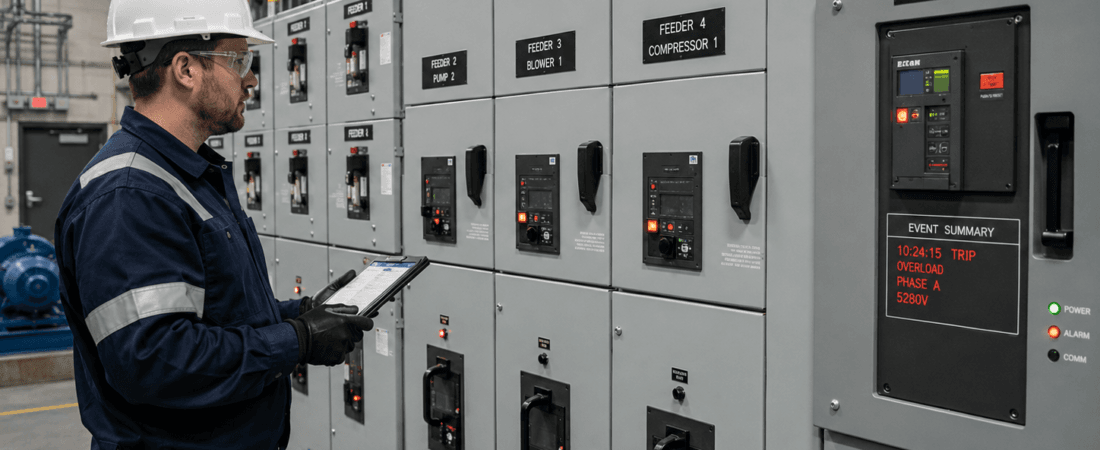

An MCC main breaker trip changes the situation immediately.
Several motors stop at once.
Operators want the equipment back.
Production pressure starts building.
And one question usually comes quickly:
“Can we reset the breaker?”
My first response is usually:
Not yet. First, find out why it opened.
A breaker reset is easy.
Understanding what caused the trip is the real troubleshooting.
When an MCC main breaker trips, I try to preserve the evidence, identify the protection that operated, locate the affected feeder, and understand why the fault reached the main breaker before making a re-energization decision.
1. Do Not Reset Before You Read the Trip Information

The first few minutes after a trip can contain the best evidence.
Before resetting anything, I want to know:
- Which trip element operated?
- Was it overcurrent?
- Short circuit?
- Ground fault?
- Undervoltage?
- External trip?
- Shunt trip from another protection system?
- Did an upstream breaker also operate?
Modern ACBs and protection relays may provide:
- Trip indication
- Fault current
- Fault phase
- Ground-fault current
- Event timestamp
- Protection element
- Event history
Once the breaker is reset, some useful information may become harder to interpret or disappear from the immediate indication.
So I record it first.
Photos help.
Event logs help even more.
2. Confirm That It Was Actually a Protection Trip
A main breaker being open does not always mean the breaker itself detected an electrical fault.
It may have opened because of:
- Shunt trip command
- Undervoltage release
- Emergency shutdown
- Fire alarm interface
- Bus protection
- Interlock logic
- Remote trip signal
- Control power disturbance
That distinction matters.
If the breaker opened on instantaneous overcurrent, I approach the situation very differently from a breaker opened by an external shutdown command.
My first question is therefore:
What actually told the breaker to open?
3. Look at the Downstream Feeders Before Touching Anything
If one downstream feeder caused the event, there may already be clues.
I check the MCC sections for indications such as:
- Feeder breaker trip
- Fuse operation
- Motor protection relay trip
- Ground-fault indication
- Contactor condition
- Overload relay indication
- VFD fault
- Soft starter fault
Sometimes one feeder immediately stands out.
For example:
Main ACB: Ground Fault Trip
and at one motor feeder:
Motor protection relay: Ground Fault
Now the troubleshooting direction becomes much clearer.
But I do not assume the first alarm is automatically the complete cause.
I compare timestamps and protection operation where possible.
4. Identify What Was Running at the Moment of the Trip

This sounds simple, but it is extremely useful.
I want to know:
- Which motors were running?
- Which equipment had just started?
- Was anything switching at that moment?
- Was maintenance work in progress?
- Did the trip happen during a process upset?
- Was equipment restarted just before the event?
A fault that occurs immediately when one motor starts tells a very different story from an MCC that trips after six hours of stable operation.
The operating sequence helps narrow the search.
5. Separate the Faulted Feeder from the Entire MCC
One of the most important questions is:
Did the whole MCC fail, or did one feeder fault and take the whole MCC down with it?
Those are very different problems.
I think of the power path like this:
Source → Main ACB → Busbar → Feeder Protection → Cable → Load
If a motor or cable fault occurred downstream, ideally the protection closest to that fault should isolate it where the system has been designed for selective coordination.
If the main breaker trips instead, I want to understand why.
Possible reasons include:
- Fault current exceeded multiple instantaneous settings
- Downstream protection did not operate
- Ground-fault protection was missing or incorrectly set
- Protection settings were not coordinated
- Fuse characteristics did not coordinate with the main breaker
- Main breaker settings were too sensitive
- Fault occurred on the MCC bus itself
- Fault was upstream of the feeder protective device
This is where troubleshooting starts becoming an engineering review.
6. Check the Faulted Circuit in Sections

Once a suspect feeder is identified and the equipment is safely isolated under the approved procedure, I prefer to divide the circuit rather than test everything as one system.
For a motor feeder, for example:
MCC → Cable → Local Junction Box → Motor
Depending on the installation, I may separate the motor from the cable and test them independently.
This helps answer:
- Is the fault inside the motor?
- Is it in the feeder cable?
- Is it in a junction box?
- Is moisture present in the terminal box?
- Is another auxiliary circuit involved?
Dividing the system usually gives more useful information than repeatedly testing the entire feeder from one end.
7. Inspect the MCC Before Re-Energization
If the main breaker experienced significant fault current, I do not only inspect the suspected load.
The MCC itself may also have experienced electrical and thermal stress.
After appropriate isolation and safe access, inspection may include:
- Main breaker condition
- Busbar area
- Feeder connections
- Cable terminations
- Fuse holders
- Contactors
- Overload relays
- Signs of arcing
- Discoloration
- Burn marks
- Unusual smell
- Loose or damaged components
A downstream fault can leave evidence upstream.
Re-energizing without checking the affected current path can create a second failure.
8. Review the Protection Settings
This is one of the steps I consider most important after a major trip.
If a small downstream fault resulted in the entire MCC shutting down, the question is not only:
“What failed?”
It is also:
“Why did the protection respond this way?”
I review, where applicable:
- Main ACB long-time setting
- Short-time pickup
- Short-time delay
- Instantaneous pickup
- Ground-fault pickup
- Ground-fault delay
- Feeder breaker settings
- Motor protection relay settings
- Fuse ratings and characteristics
The goal is not to randomly change settings after a trip.
The goal is to confirm that the actual settings still match the intended protection philosophy.
9. Check Protection Coordination

This is where a single equipment failure can reveal a system-level weakness.
Suppose one small motor develops an insulation fault.
The motor should stop.
But if the MCC main breaker trips first, dozens of unrelated loads may stop with it.
That creates a much larger plant disturbance.
So after identifying the original fault, I ask:
Was the correct protective device supposed to operate first?
If the answer is yes—but it did not—the incident deserves a coordination review.
That may involve checking the time-current characteristics of:
Main ACB → Feeder Breaker/Fuse → Motor Protection
The equipment failure and the protection performance should be reviewed separately.
10. Decide What Must Be Isolated Before Power Comes Back
The goal is not always to repair everything before restoring the MCC.
Sometimes the faulted feeder can be positively identified, safely isolated, and left out of service while healthy sections are restored.
But that decision should be based on evidence.
Before considering re-energization, I want reasonable confidence that:
- The faulted circuit has been identified
- The affected feeder is isolated
- No visible damage remains on the common bus or main current path
- The main breaker is in acceptable condition
- Protection settings have not been arbitrarily changed
- There is no unresolved evidence of a bus fault
- The approved operating and safety procedures allow restoration
If the cause is still unknown, I treat that uncertainty as part of the risk.
My Practical Sequence After an MCC Main Breaker Trip
I generally think through the event in this order:
1. Preserve the Evidence
Record:
- Main breaker trip indication
- Relay events
- Fault current
- Fault phase
- Time of trip
- Alarm history
2. Identify What Operated
Was it:
- Overcurrent?
- Ground fault?
- Undervoltage?
- External trip?
- Shunt trip?
3. Look Downstream
Check:
- Feeder breakers
- Fuses
- Motor protection relays
- VFDs
- Contactors
- Overloads
4. Reconstruct the Moment of Failure
Ask:
- What equipment was running?
- What had just started?
- What changed immediately before the trip?
5. Locate the Fault
Work through:
Main Bus → Feeder → Cable → Load
6. Review the Protection
Check:
Did the device closest to the fault operate as intended?
7. Make the Restoration Decision
Restore only after the faulted section is identified and appropriately isolated, and the remaining system has been assessed under the approved procedure.
MCC Main Breaker Trip — Field Checklist
Before Resetting
- Record the main breaker trip indication
- Save relay and breaker event logs
- Record fault current and fault phase if available
- Check whether an external trip signal operated
- Check upstream breaker status
Find the Suspect Feeder
- Check downstream breaker trips
- Check blown fuses
- Check motor protection relay events
- Check VFD or soft starter faults
- Identify equipment running at the trip time
- Identify equipment that had just started
Inspect and Isolate
- Identify the likely faulted feeder
- Follow approved LOTO procedures
- Divide cable and load where appropriate
- Check motor/cable insulation where applicable
- Inspect terminals and junction boxes
- Inspect the affected MCC current path
Review Protection
- Main ACB trip element
- Feeder breaker/fuse operation
- Motor protection settings
- Ground-fault settings
- Protection coordination
- Confirm settings against approved engineering data
Before Re-Energization
- Faulted section identified
- Faulted feeder isolated
- No unresolved evidence of bus damage
- Main breaker condition checked
- Remaining system considered safe for restoration
- Operations and responsible personnel informed
Final Thought
After an MCC main breaker trip, the fastest action is usually obvious:
Reset the breaker.
But that is rarely the most useful first action.
The trip itself contains information.
Preserve it.
Find which protection operated.
Find where the fault occurred.
Then ask one more question:
Did the protection system isolate the fault the way it was supposed to?
Because sometimes the failed motor is only the first problem.
The second problem is discovering that one small fault was able to shut down the entire MCC.
That lesson is worth finding before the next trip.
Safety Notice
MCCs can contain hazardous voltage, high available fault current, stored energy, and arc-flash hazards.
Troubleshooting, inspection, testing, isolation, and restoration should only be performed by qualified personnel following approved site procedures and applicable electrical safety requirements.
Do not open or inspect energized MCC compartments solely for troubleshooting convenience.
Before accessing isolated equipment:
- Identify all electrical energy sources
- Follow approved lockout/tagout procedures
- Consider control, UPS, DC, and backfeed sources
- Verify absence of voltage where required using appropriately rated equipment
- Use required PPE
- Follow site authorization and restoration procedures
A production restart should never take priority over establishing a safe electrical condition.