
Critical Environment Electrical Engineering Series — Part 2
A UPS is often described as a battery backup.
That description is not completely wrong.
But in a critical environment, it is far too small.
In a home office, a UPS may simply give you a few minutes to save your work and shut down a computer safely. In a small control panel, it may keep a PLC, HMI, or network switch alive during a short power interruption.
But in a data center or any mission-critical facility, a UPS has a much bigger role.
It is not just a battery.
It is the electrical buffer between disturbance and continuity.
The Common Misunderstanding About UPS
Many people think about UPS systems only when there is a blackout.
The utility power fails.
The battery takes over.
The load keeps running for a while.
That is the simple version.
But real power problems are not always complete blackouts.
A critical load can be affected by many types of disturbances:
- Momentary interruption
- Voltage sag
- Voltage swell
- Frequency deviation
- Transient overvoltage
- Switching disturbance
- Unstable generator transfer
- Poor power quality from the upstream system
For ordinary loads, some of these events may not matter much.
A light may flicker.
A motor may ride through.
A small device may restart.
But critical IT equipment, network systems, storage devices, control systems, and communication equipment may not tolerate even a short disturbance.
This is why UPS should not be understood only as a backup power device.
It should be understood as a power continuity device.
Why Critical Environments Need a Different UPS Mindset
Traditional buildings often use emergency power to support selected essential loads.
Emergency lighting, fire protection systems, elevators, security systems, and a limited number of control loads are typical examples.
The goal is usually safety and minimum operation during a power failure.
A data center has a different goal.
The goal is continuous operation.
The servers should not shut down.
The network should not drop.
The storage system should not lose power.
The facility should not wait for a generator to become stable before the critical load is protected.
In this kind of environment, even a few seconds can be too long.
That changes the role of UPS.
A UPS is not installed only for convenience.
It becomes one of the central systems in the critical power architecture.
The Gap Between Utility Power and Generator Power
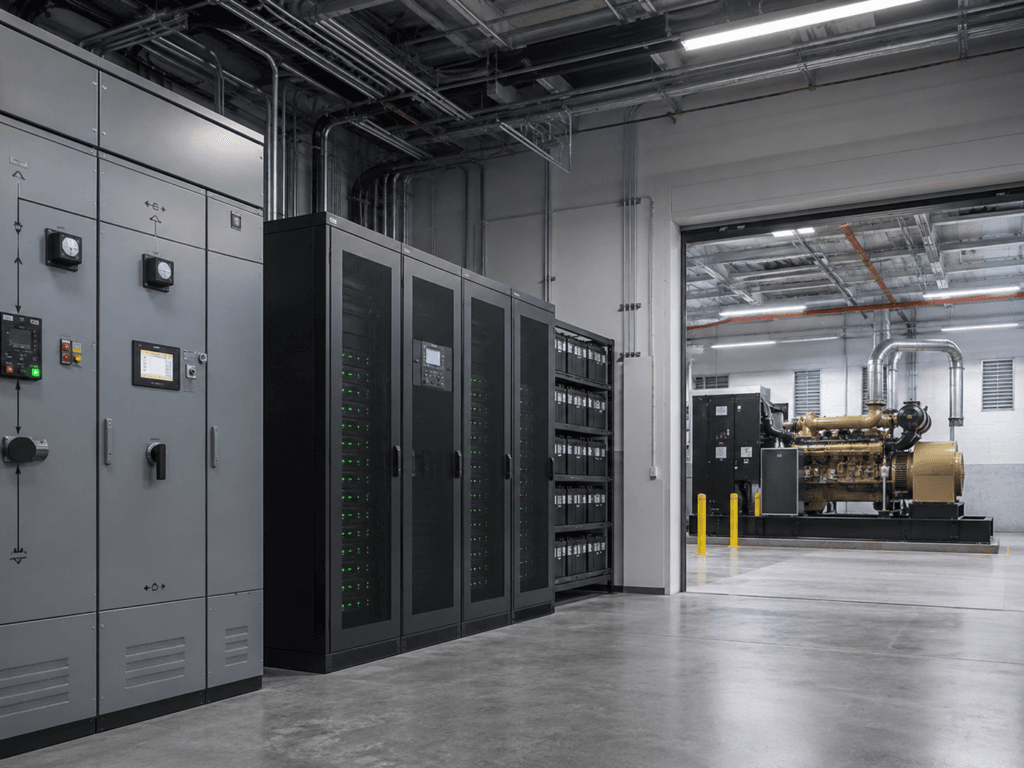
When utility power fails, the generator does not instantly support the load.
Several things must happen first.
The system has to detect the power failure.
The generator has to start.
Voltage and frequency must build up.
The generator must become stable.
The transfer system must operate correctly.
The generator must accept the load without excessive voltage or frequency drop.
This entire sequence takes time.
During that time, the critical load still needs power.
This is one of the most important roles of the UPS.
The UPS bridges the gap between utility failure and generator availability.
Without UPS, the load would experience an interruption before the generator is ready. With UPS, the critical load can continue operating while the backup generation system starts and stabilizes.
In other words, the generator may provide long-duration backup power.
But the UPS protects the first moment.
And in critical power systems, the first moment matters.
UPS Also Protects Against Power Quality Problems
A blackout is easy to understand.
Power is either present or absent.
But many electrical problems are more subtle.
A voltage sag may last only a few cycles.
A transient may be extremely short.
A switching event may disturb the waveform.
A weak utility source may create unstable voltage conditions.
These events may not look serious from the outside.
But for sensitive loads, they can create real problems.
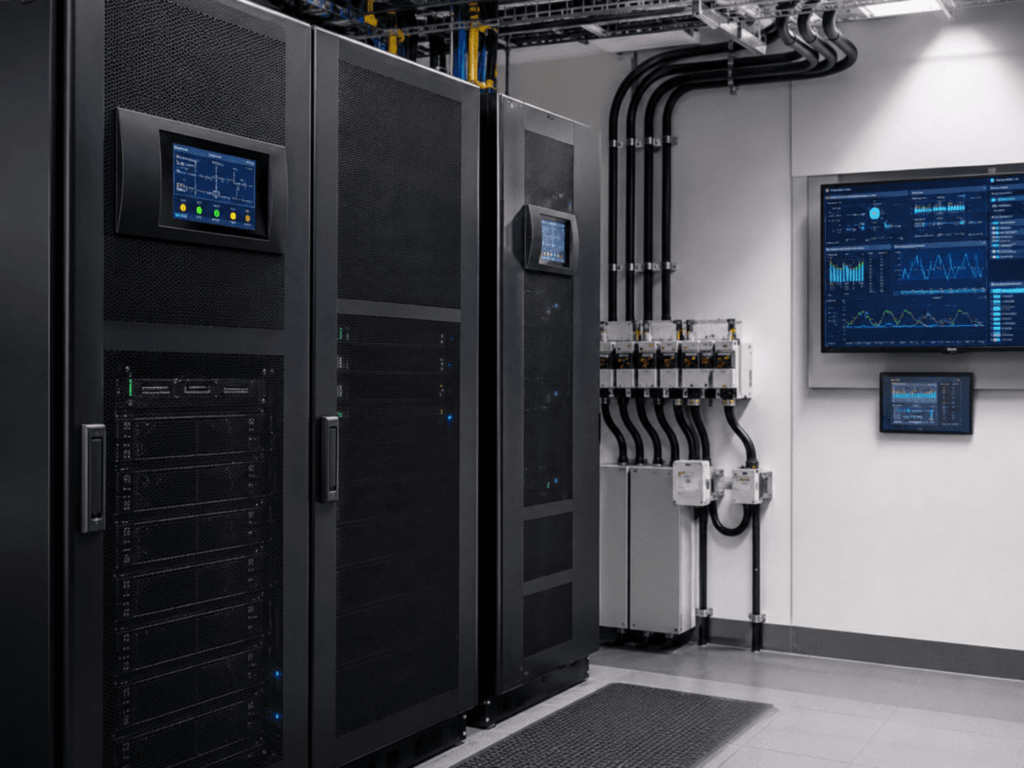
This is why UPS systems are also part of power quality strategy.
They help isolate the critical load from upstream disturbances and provide a more stable power path.
This does not mean UPS solves every power quality problem.
Voltage sag protection, grounding, harmonics, power factor, switching transients, and system coordination still need to be reviewed separately.
But UPS is one of the first layers of defense.
UPS Is Part of the Architecture, Not Just a Device
One mistake is to think of UPS as a standalone box.
In critical environments, a UPS must be considered as part of the entire electrical system.
It is connected to the utility source, switchgear, transformers, generators, batteries, bypass circuits, distribution panels, monitoring systems, and maintenance procedures.
The UPS itself may be reliable.
But the system can still fail if the surrounding architecture is weak.
For example:
A bypass path may not be properly designed.
A breaker may not coordinate correctly.
A battery system may not be maintained.
A transfer sequence may not be tested.
A single control power source may become a hidden weak point.
A maintenance activity may accidentally expose the load to risk.
This is where critical environment electrical engineering becomes different from ordinary equipment selection.
The question is not only:
“Which UPS should we buy?”
The better question is:
“How should the UPS fit into the complete power architecture so that the critical load remains protected?”
A Field-Oriented Way to Look at UPS
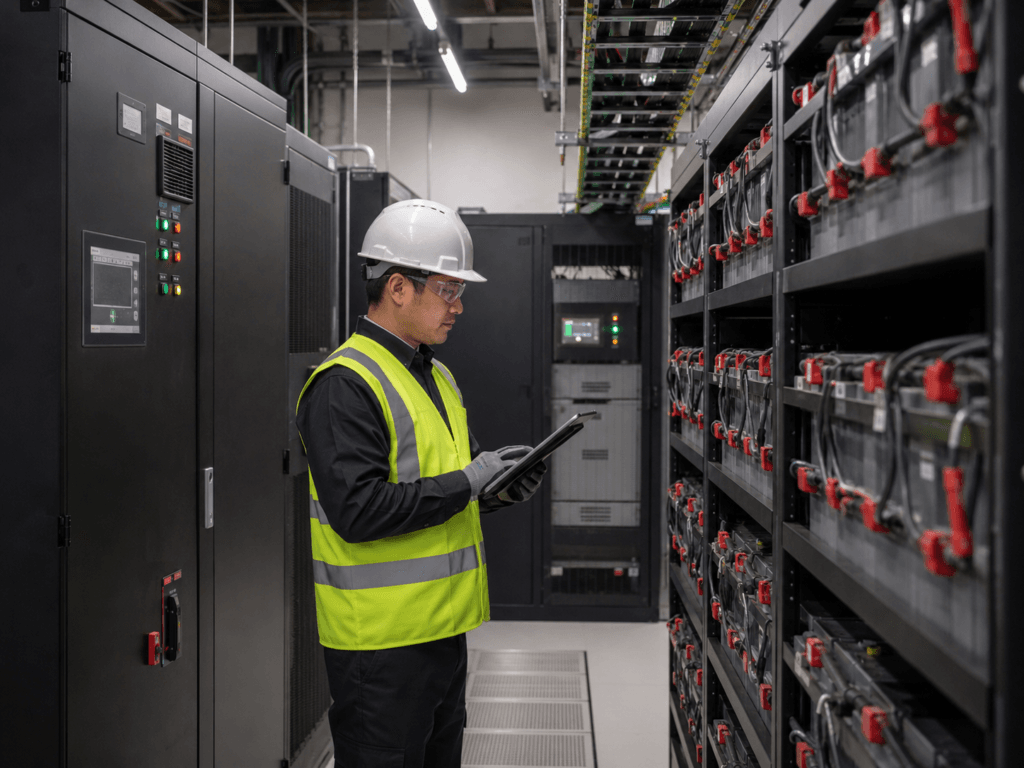
From a field engineering perspective, a UPS should be reviewed with practical questions.
What load does it protect?
How long should it support the load?
What happens when utility power fails?
What happens when the generator starts?
What happens if the UPS itself fails?
Is there a bypass path?
Can the UPS be maintained without shutting down the critical load?
Are alarms and battery conditions monitored properly?
Has the transfer sequence been tested under realistic conditions?
These questions may sound simple.
But in real facilities, many problems appear not because equipment is missing, but because interfaces are not fully understood.
A UPS is not just an electrical product.
It is a point where design, operation, maintenance, and risk management meet.
Closing
In a critical environment, UPS is not just a battery backup.
It is the first line of defense between electrical disturbance and operational continuity.
The generator may support long-duration operation.
The switchgear may distribute power.
The protection system may isolate faults.
The monitoring system may provide visibility.
But the UPS protects the critical load during the most sensitive moment.
That is why understanding UPS is one of the first steps in understanding critical power systems.
In the next article, we will look at UPS topologies and how different UPS architectures are used in critical environments.