
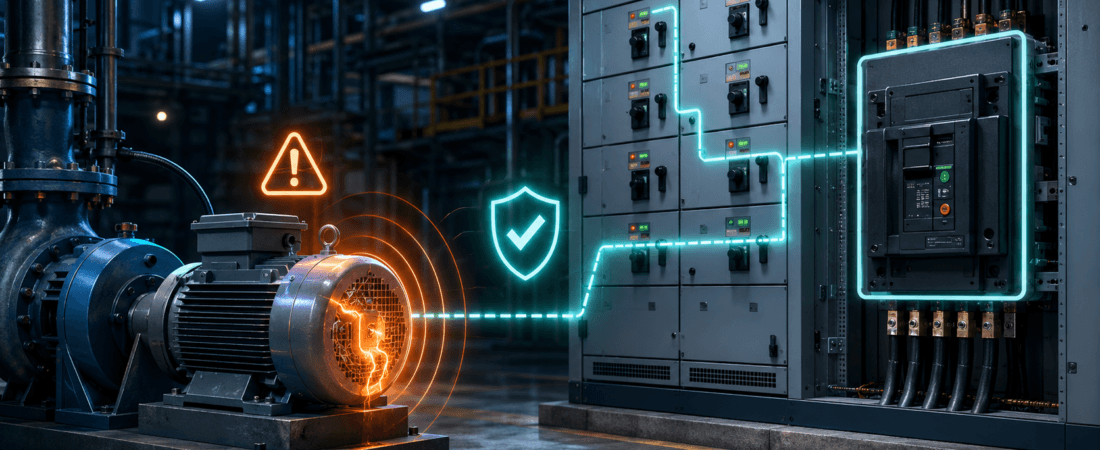

A field note on motor protection, MCC coordination, and why small faults must stay local.
A small motor fault should stop one motor.
It should not trip the main breaker and affect a wider part of the plant.
That sounds obvious. But in real industrial facilities, small problems do not always stay small. A mechanical jam, an overloaded motor, an incorrectly set protection device, or a missed coordination review can allow a local equipment issue to move upstream.
When that happens, the problem is no longer just a motor problem.
It becomes an electrical protection problem.
It becomes an MCC reliability problem.
And in the worst case, it becomes a plant operation problem.
This field note is about one simple principle:
Small faults should remain small.
That is the purpose of protection coordination.
What happened?
In an industrial facility, a small motor-driven package experienced an abnormal mechanical load condition.
The equipment itself was not large. It was not a main process compressor, a large pump, or a major electrical feeder. It was a relatively small motor compared with the overall electrical system.
But the event did not stay at the motor level.
The motor continued operating under abnormal load conditions until the fault escalated electrically. Instead of being cleared by local or downstream protection, the event propagated upstream and eventually caused the main ACB of the MCC to trip.
A local equipment problem became a wider shutdown event.
The important question is not only:
“Why did the motor fail?”
The better question is:
“Why was the fault not cleared at the right level?”
Fault detection is not enough
Many people think electrical protection is mainly about detecting faults.
That is only half true.
A protection system must detect the fault, but it must also clear the fault at the correct location.
If a small motor has an overload or stall condition, the local protection device should operate first. Depending on the design, this could involve an electronic overload relay, motor protection relay, MPCB, thermal overload relay, feeder breaker, or another downstream protective device.
The upstream MCC main breaker should not be the first device to operate for a local motor problem.
When an upstream breaker trips before the local protection acts, the system may technically have “protected” itself, but it failed from an operational reliability perspective.
The equipment was disconnected, yes.
But too much equipment was disconnected.
That is the difference between protection and selective protection.
The fault path
A simplified fault path may look like this:
- A motor-driven package experiences abnormal mechanical load.
- The motor enters an overload or stall condition.
- Local protection does not operate as expected.
- The fault continues or escalates.
- Upstream protection finally operates.
- The MCC main ACB trips.
- Multiple loads are affected.
From the operator’s point of view, the result may simply look like:
“The MCC tripped.”
But from an engineering point of view, the more important question is:
“Why did the system allow a local fault to reach the MCC main breaker?”
That question leads to protection settings, device coordination, maintenance practices, and operating philosophy.
The real issue: protection selectivity
The real issue is not only the motor.
The real issue is protection selectivity.
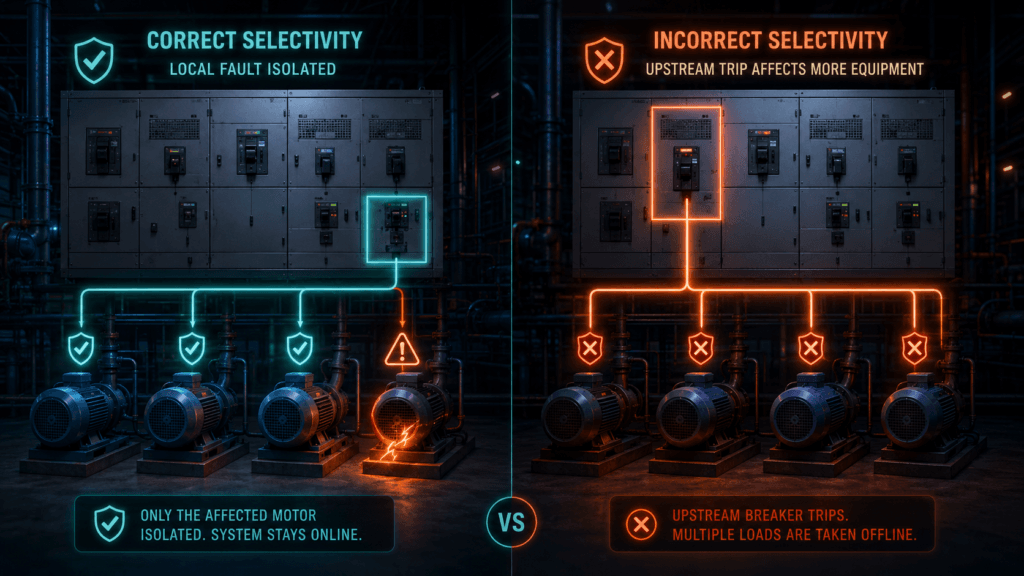
Protection selectivity means that the protective device closest to the fault should operate first, while upstream devices remain closed unless the downstream device fails or the fault is beyond its clearing capability.
In simple terms:
- A motor fault should trip the motor protection.
- A feeder fault should trip the feeder protection.
- A bus fault should trip the bus or main protection.
- A main breaker should not trip for every downstream fault.
This hierarchy matters because electrical systems are not only designed to prevent damage. They are also designed to preserve operation.
A well-coordinated system does not just ask:
“Can we trip during a fault?”
It asks:
“Can we trip only what needs to be tripped?”
That is the operational value of protection coordination.
What should have happened?
For a small motor fault, the ideal response is simple:
The affected motor should be isolated locally.
The local protection device should detect the abnormal current, overload, stall condition, or other fault signature and trip before the upstream MCC main breaker operates.
The upstream breaker should remain closed.
The rest of the MCC should remain energized.
The plant should not experience a wider shutdown because of one small motor.
Of course, real systems are more complex than a simple diagram. There may be different fault types, different device capabilities, different time-current curves, and different coordination limits.
But the basic philosophy remains the same:
The protection device closest to the fault should have the first opportunity to clear it.
If that does not happen, the event deserves a protection coordination review.
What may have been missed?
When a small motor fault trips an upstream breaker, several items should be reviewed.
1. Local protection setting
Was the motor protection actually set?
A protection device installed in the panel is not the same as a protection device properly configured for the load.
The setting should reflect the motor rating, service factor, expected starting current, load profile, and process conditions.
If the setting is too high, the device may not operate during abnormal load conditions.
If the setting is too low, nuisance trips may occur.
Both are problems.
The correct setting must be intentional, documented, and verified.

2. Trip class and operating time
Motor loads are not all the same.
Some motors start quickly. Others have high inertia and require longer acceleration time. Some loads may experience temporary overload during normal operation. Others may need fast protection due to mechanical risk.
The trip class or time delay must match the actual application.
If the device response is too slow, upstream protection may operate first during escalation.
If the device response is too fast, the motor may trip during normal starting or process variation.
Protection is not just about current level.
Time matters.
3. Motor stall or jam condition
A mechanical jam is not always treated seriously enough from the electrical side.
But from the motor’s perspective, a jam or locked-rotor condition can rapidly become a severe electrical and thermal event.
If the motor cannot accelerate or if the driven equipment becomes mechanically locked, current may remain high for longer than expected.
In that situation, the protection system must recognize the abnormal condition before the fault escalates.
This is where motor stall protection, overload protection, thermal model settings, or process interlocks may become important.
The mechanical problem may begin the event.
But the electrical protection system determines how far the event spreads.
4. Upstream breaker setting
The upstream breaker setting must also be reviewed.
If the upstream breaker operates too early compared with the downstream protective device, the system may lose selectivity.
This does not always mean the upstream breaker is “wrong.” Sometimes upstream settings are intentionally conservative. Sometimes coordination is limited by available short-circuit current, device type, or system constraints.
But if one small motor fault trips the MCC main ACB, the upstream setting should not be ignored.
At minimum, engineers should review the coordination relationship between:
- Motor protection
- Feeder protection
- MCC main breaker
- Upstream distribution protection
The goal is not to make the upstream breaker slow without thinking.
The goal is to ensure that each device operates at the correct level for the correct fault.
5. Change management
Protection settings often become outdated because the system changes over time.
Motors are replaced. Loads are modified. Process conditions change. Panels are expanded. Protection devices are upgraded. Operators change operating methods. Maintenance teams replace equipment with “equivalent” models.
Each change may look small.
But over time, the actual system may no longer match the original protection study.
This is why protection coordination is not a one-time design document.
It must be reviewed when field conditions change.
A protection system that was correct five years ago may no longer be correct today.
A protection device is not decoration
One of the strongest lessons from this type of event is simple:
A protection device that is installed but not properly set is only decoration.
It may look complete on the drawing.
It may look correct inside the panel.
It may even have a label, a model number, and a healthy status light.
But if the setting does not match the equipment, the load, and the coordination philosophy, it may not protect the system when it matters.
Protection must be verified, not assumed.
That means engineers should ask practical questions:
- Is the protection device actually enabled?
- Is the current setting correct?
- Is the trip delay appropriate?
- Has the motor starting behavior been checked?
- Has the mechanical load condition been considered?
- Is the upstream breaker coordinated with the downstream device?
- Has any equipment been modified since the last review?
- Can one small motor fault affect the whole MCC?
These questions are simple.
But they are often only asked after a trip.
Field checklist
When reviewing a motor fault that caused an upstream trip, start with this checklist.
Motor and load
- What is the motor rating?
- What is the normal running current?
- What is the actual load profile?
- Is the load high-inertia, intermittent, or prone to jamming?
- Was there any mechanical abnormality before the trip?
Local protection
- What protection device is installed?
- Is the protection function enabled?
- Are the current settings correct?
- Is the trip class or delay appropriate?
- Does the setting match the motor nameplate and actual operating condition?
- Is stall or locked-rotor protection required?
Coordination
- Which device should have tripped first?
- Which device actually tripped first?
- Are downstream and upstream devices selectively coordinated?
- Are time-current curves available and updated?
- Has the MCC main breaker setting been reviewed?
- Could the same fault happen again?
Maintenance and management
- Were protection settings documented?
- Were settings changed during maintenance?
- Was the equipment modified after commissioning?
- Is there a periodic review process?
- Are operators trained on what each trip level means?
This checklist does not replace a full protection study.
But it gives a practical starting point for field investigation.
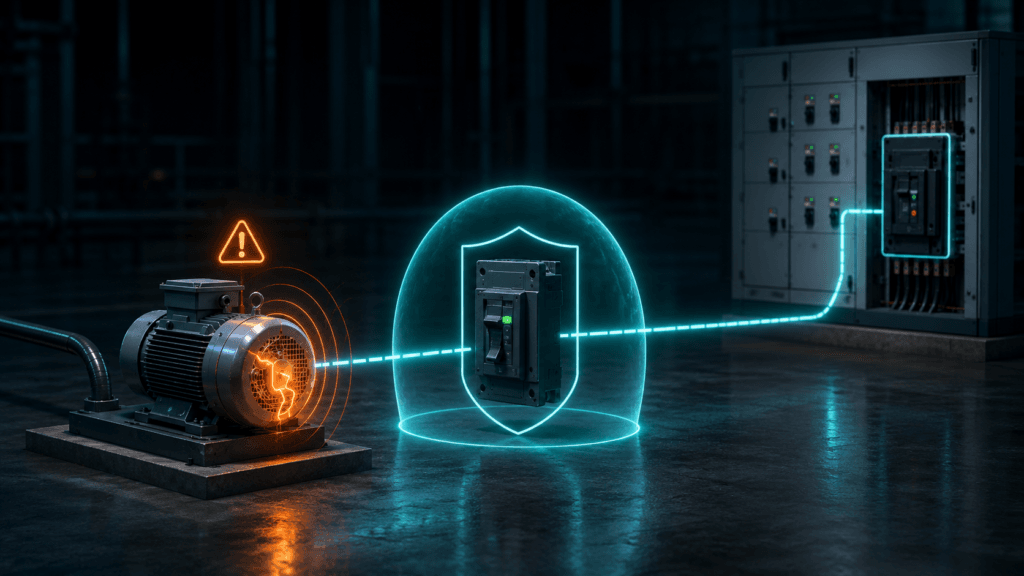
Final takeaway
A small motor fault should not trip the main ACB.
If it does, the event should not be treated only as a failed motor or a nuisance trip.
It should be treated as a warning sign.
A warning sign that local protection may not be properly set.
A warning sign that selectivity may not be working as intended.
A warning sign that the electrical system may be allowing small problems to become large events.
In industrial facilities, reliability is not only built by installing strong equipment.
Reliability is built by making sure each part of the system responds at the right time, at the right level, and with the right consequence.
Small faults should remain small.
That is the purpose of protection coordination.