
Electrical design review often involves more than checking whether one document is correct.
The real challenge is making sure multiple documents agree with each other.
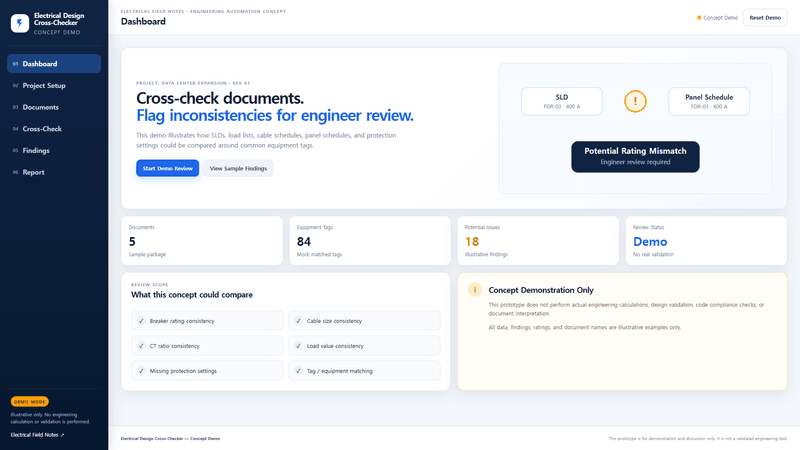
A breaker rating may be updated on the Single-Line Diagram but remain unchanged in the panel schedule.
A cable size may be different between the drawing and the cable schedule.
A CT ratio may not match the protection settings.
None of these checks are particularly difficult.
But when a project contains hundreds of feeders, multiple revisions, and several interconnected documents, repetitive comparison becomes time-consuming.
And repetitive work is where human error becomes more likely.
That made me wonder:
Can AI review multiple electrical documents to save engineering time and reduce human error?
The Idea: Electrical Design Cross-Checker
I started sketching a concept called the Electrical Design Cross-Checker.
The goal is not to let AI approve an electrical design.
The goal is to use AI and automation to support the repetitive part of design review.
For example, the system could compare information across:
- Single-Line Diagrams
- Load Lists
- Cable Schedules
- Panel Schedules
- Protection Settings
and highlight potential inconsistencies for an engineer to review.
The basic workflow could look like this:
Documents → Data Extraction → Equipment Matching → Cross-Check → Findings → Engineer Review
Let AI Read, Let the System Compare
One thing I would not want to do is simply upload several documents and ask:
“Is this design correct?”
That gives too much responsibility to the AI.
A more practical architecture would separate the roles.
AI
Use AI mainly to extract and interpret information from unstructured documents.
For example:
- Equipment Tag
- Voltage
- Breaker Rating
- Cable Size
- CT Ratio
- Load
- Protection Setting
Application Logic
The application then performs structured comparisons.
For example:
FDR-03
SLD: 400 A
Panel Schedule: 600 A
Result:
Potential Breaker Rating Mismatch
This part does not necessarily need AI.
A simple rule can determine that two values are different.
Engineer
The engineer makes the final decision.
The mismatch may be:
- a design error
- an outdated revision
- an intentional design change
- a temporary discrepancy
- or simply an AI extraction error
So the system should never say:
“This design is wrong.”
It should say:
“Potential inconsistency detected. Engineer review required.”
A Possible Local Application Architecture
I am currently considering building this as a local web application rather than a traditional desktop application.
The structure could be:
Web UI
↓
Node.js + Express
↓
SQLite
↓
Local Document Storage
AI analysis could then be added through an external API.
For API credential security, the API key would not be stored directly in the application source code or browser.
One possible structure is:
Local Application → Azure Key Vault → OpenAI API
This would allow the application to keep project files, findings, and review data locally while using AI only when document interpretation is required.
Why a Local Web Application?
For this type of engineering tool, a local web application has several advantages.
The user interface can still behave like a modern web application, but the project data can remain on the engineer’s computer.
There is no need to build a separate Windows interface using WPF or another desktop framework.
The application could simply run locally:
http://localhost:3000
From the user’s perspective, it would still feel like a normal application.
The browser becomes the interface.
Start Small
Trying to automatically verify an entire electrical design package from day one would probably be a mistake.
A better Minimum Viable Product (MVP) could start with only two documents.
For example:
Single-Line Diagram + Load List
And only a few checks:
- Equipment Tag
- Rated Load
- Voltage
- Breaker Rating
The result could simply be:
MATCH
MISMATCH
NOT FOUND
REVIEW REQUIRED
If that works reliably, more documents can be added later.
The Bigger Question
I think the interesting part is not whether AI can completely replace electrical design review.
I do not think that is the right target.
The more useful question is:
Which parts of engineering review are repetitive enough to automate, but important enough that missing them creates real risk?
Finding mismatched numbers between multiple documents is not the most intellectually difficult part of electrical engineering.
But it consumes attention.
If AI and automation can handle more of that repetitive work, engineers can spend more time on decisions that actually require engineering judgment.
Things like:
- system reliability
- protection philosophy
- maintainability
- failure scenarios
- redundancy
- safety
That seems like a much better use of engineering time.
Current Status
This is still an early-stage concept.
No automated engineering validation has been implemented yet.
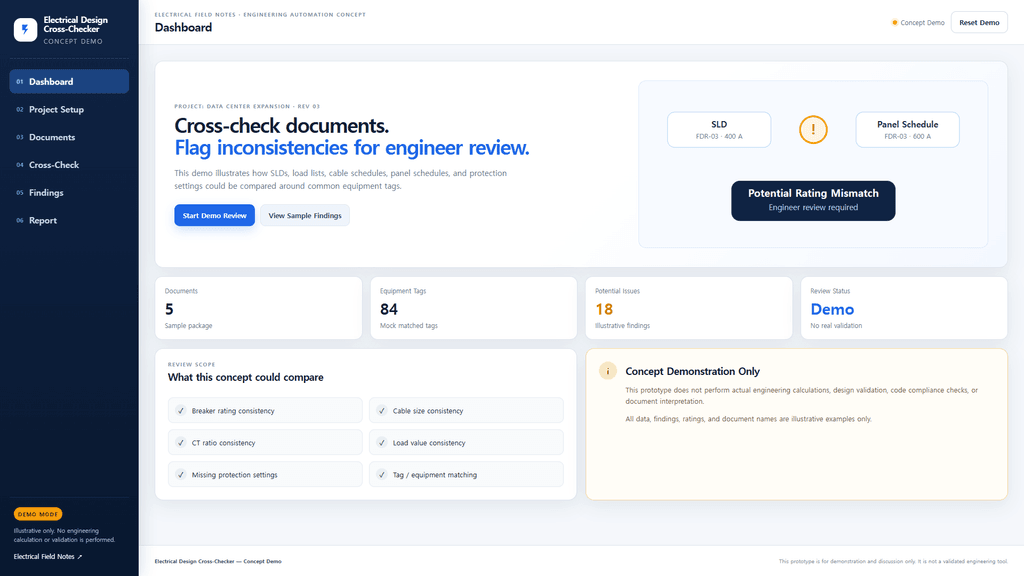
I have created a clickable mockup to explore how the workflow and user interface could look.
Concept Demo:
https://electricalfieldnotes.com/electrical-design-cross-checker/
The next step is not to build everything.
It is to pick one small cross-checking problem and see whether the idea actually works.
Concept first. Validate next. Build only what proves useful.
The goal is not AI-approved engineering.
The goal is AI-assisted engineering review.