
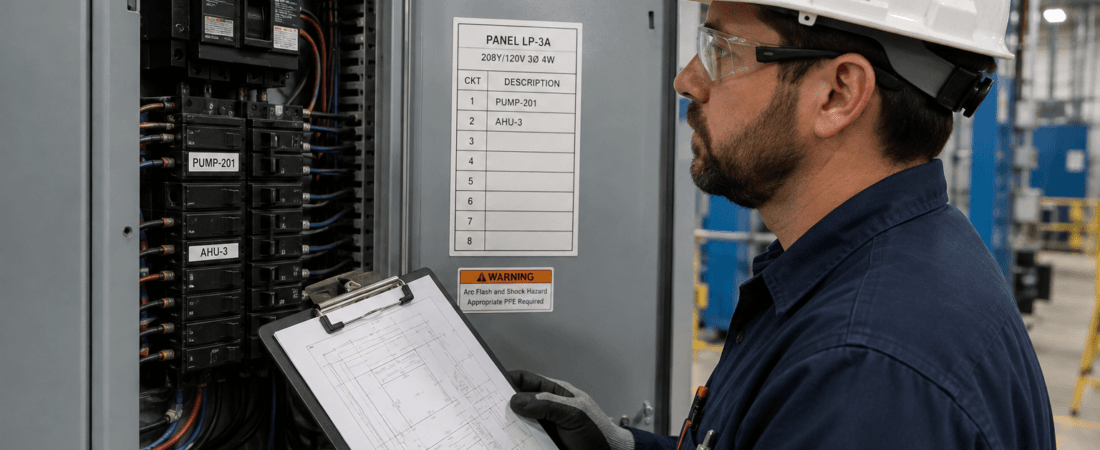
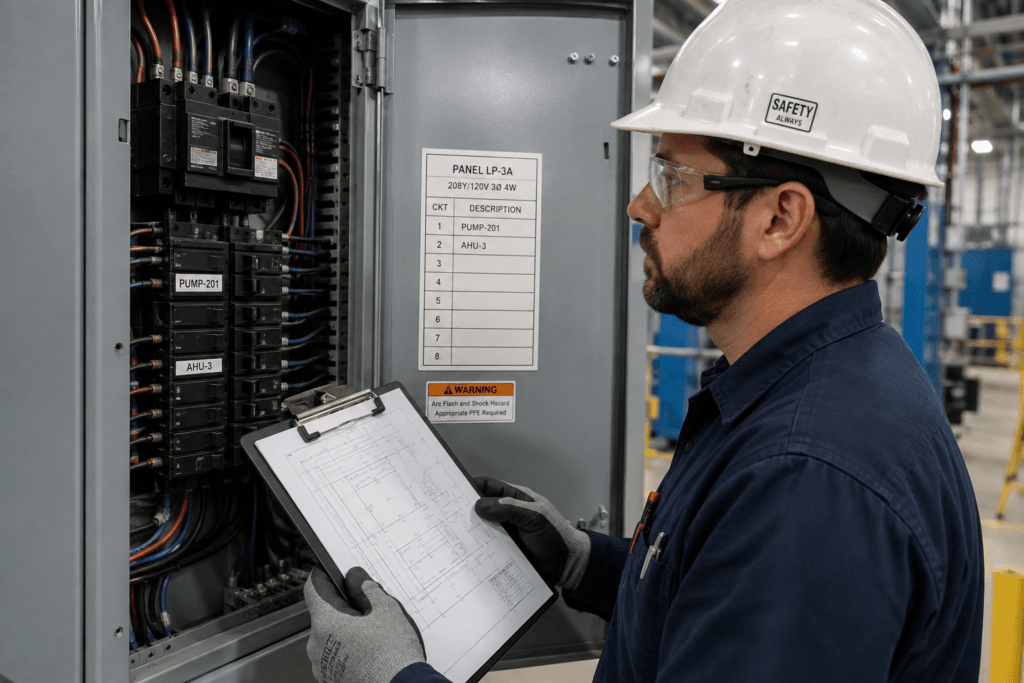
The breaker label says:
PUMP-XXX
The panel schedule says the same thing.
So the circuit must feed Pump-XXX.
Right?
Not necessarily.
Panels change.
Loads move.
Temporary wiring becomes permanent.
Old equipment is removed.
New equipment gets connected.
And sometimes the label is the only thing that never gets updated.
That is why I treat a panel label as useful information—
but never as proof of what the circuit actually feeds.
The Label May Have Been Correct Once
Most wrong labels did not start out wrong.
They became wrong over time.
A plant modification may have moved the load to another feeder.
A spare breaker may have been reused.
A motor may have been replaced and renamed.
A temporary cable may have remained in service.
A panel schedule may have been updated while the field label was not.
Or the field label may have changed while the drawing stayed the same.
Eventually, three different sources can tell three different stories:
Panel Label → Drawing → Actual Wiring
And only one of them controls what happens when the breaker opens.
1. “SPARE” Does Not Always Mean Spare
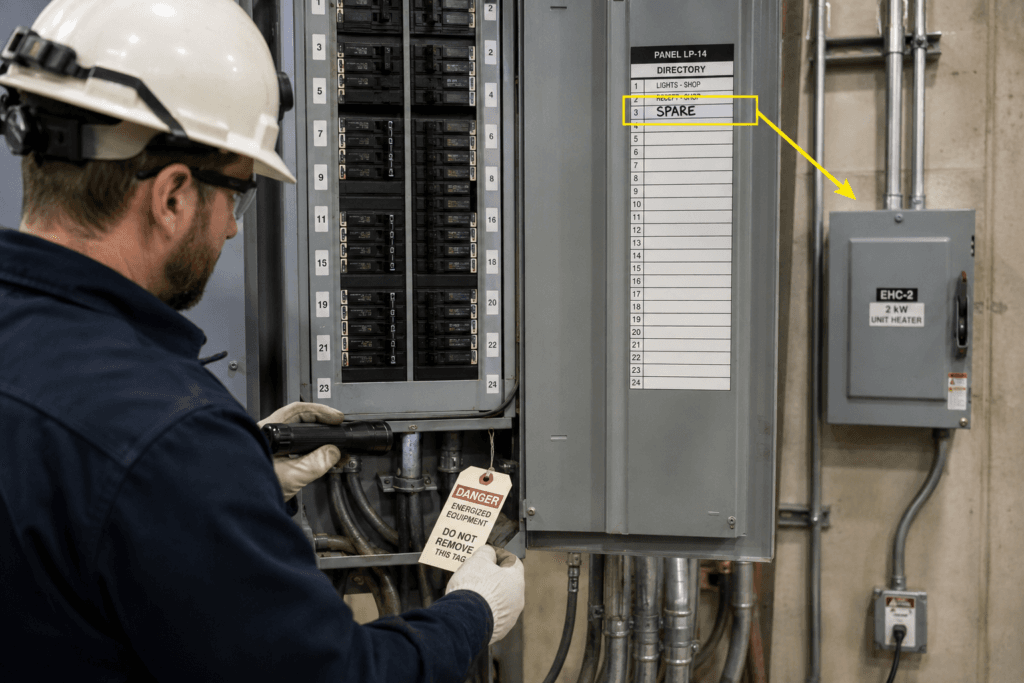
This is one of the labels I would be most careful with.
A breaker marked SPARE may actually feed:
- A small heater
- A local panel
- A convenience receptacle
- Temporary equipment
- A tracing circuit
- A control transformer
- Equipment added during a previous modification
The breaker may have been reused without updating the directory.
The absence of a clear load name does not mean the circuit is unused.
Never assume a circuit is dead or unused because the label says SPARE.
2. The Equipment Name May Be Right—but the Circuit May Not Be
Sometimes the label is partially correct.
For example:
Cooling Water Pump A
The breaker may indeed belong to that system.
But does it feed:
- The motor?
- The local control panel?
- The space heater?
- The auxiliary oil pump?
- A control transformer?
A familiar equipment name can create false confidence.
The question is not only:
“Does this label look reasonable?”
The better question is:
“What exactly does this breaker disconnect?”
3. Do Not Forget Multiple Power Sources
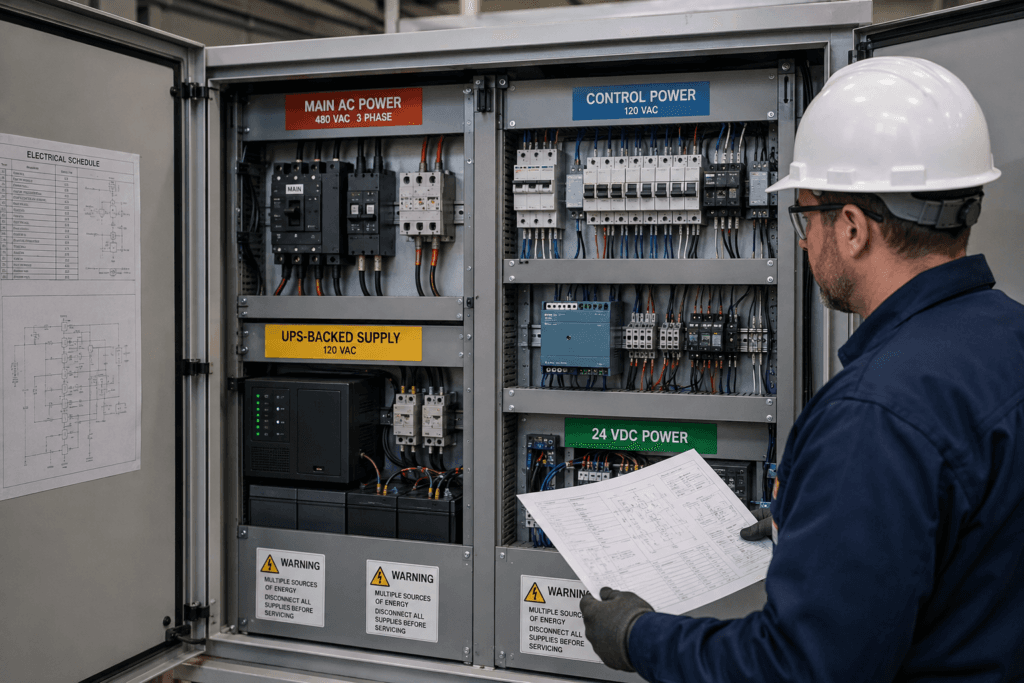
Modern equipment often has more than one source of electrical energy.
A cabinet may have:
- Main AC power
- Separate control power
- UPS-backed control power
- External 24 VDC
- Space heater supply
- Redundant power supplies
- Generator or emergency supply
- Backfeed from another panel
Opening the breaker identified on the panel may remove the main source while leaving another circuit energized.
This is especially important around:
- MCCs
- PLC panels
- UPS systems
- Automatic transfer systems
- Variable frequency drives
- Battery systems
- Interconnected control panels
One label rarely tells you the entire energy picture.
4. Compare the Label with the Drawings
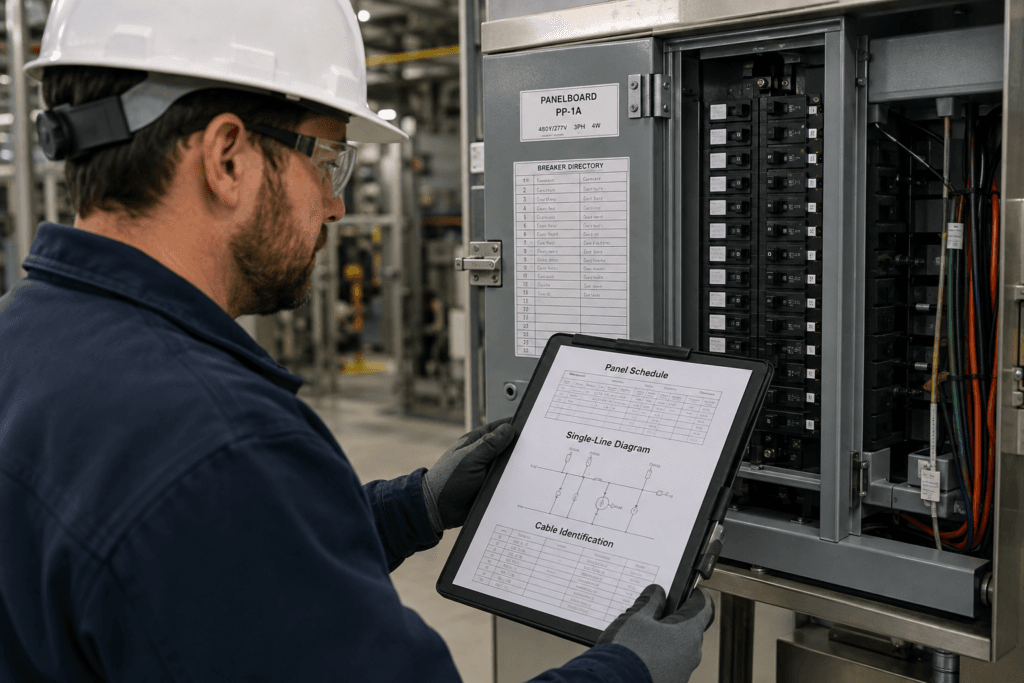
The panel schedule is one reference.
The single-line diagram is another.
Cable schedules, termination drawings, MCC schedules, and equipment drawings may provide additional clues.
Before planned electrical work, compare the available documents.
Look for inconsistencies such as:
- Different equipment names
- Different breaker numbers
- Different cable numbers
- Different source panels
- Different voltage levels
- Equipment shown as removed but still installed
- Spare circuits that contain connected cables
If the documents disagree, do not simply choose the newest-looking one.
The disagreement itself is a troubleshooting finding.
5. Look at the Physical Circuit
Documentation can tell you what should exist.
The field tells you what actually exists.
Without exposing personnel to energized parts, an approved inspection may include checking:
- Cable identification
- Feeder route
- Equipment nameplate
- Panel designation
- Cable tags
- Junction boxes
- Local disconnect identification
- Source and destination markings
A cable tag that agrees with the panel label and drawing increases confidence.
But even several matching labels are still documentation.
They are not a substitute for an approved electrical isolation and verification procedure.
6. Wrong Labels Become Most Dangerous During Isolation
A labeling error may sit unnoticed for years.
Then someone needs to isolate equipment.
They find the breaker marked with the equipment name.
They open it.
The machine stops.
Everything appears correct.
But another source remains energized.
Or the wrong circuit was opened while the intended circuit remains live.
That is where a simple documentation error becomes an electrical safety hazard.
For electrical work, isolation must be established through the approved procedure—not through the label alone.
7. Verify Before You Trust
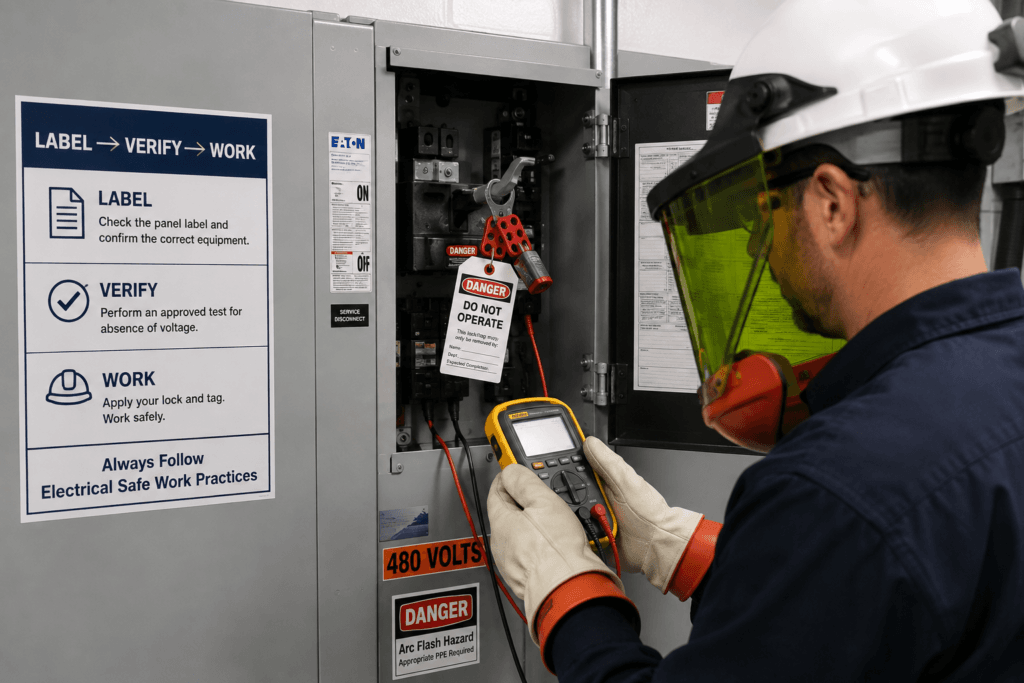
A good label is valuable.
It speeds up troubleshooting.
It reduces mistakes.
It makes maintenance easier.
But the safest mindset is:
Label → Verify → Work
Not:
Label → Assume → Work
The exact verification method depends on the equipment, voltage level, work scope, and site procedure.
For de-energized electrical work, qualified personnel should follow the approved isolation and lockout/tagout process and verify absence of voltage using an appropriately rated test instrument.
Where required by procedure, use the established live-dead-live test method to confirm the tester is functioning before and after the absence-of-voltage test.
A Practical Field Check
When a panel label becomes part of an electrical decision, I would check the following.
Documentation
- Does the panel schedule match the equipment?
- Does the single-line diagram agree?
- Does the cable schedule agree?
- Have there been modifications to the system?
Field Identification
- Does the cable number match?
- Does the local equipment tag match?
- Is there a local disconnect?
- Are there other power supplies entering the equipment?
Isolation
- What energy sources must be isolated?
- Is UPS or DC control power present?
- Could there be another feeder or backfeed?
- Has the circuit been verified according to the approved procedure?
After the Job
If a wrong label is discovered:
Fix the label.
Do not leave the discrepancy for the next person.
Update the relevant field identification and documentation through the site’s change-control process.
Field Checklist
Before trusting an electrical panel label:
- Confirm the panel and breaker designation
- Compare with the panel schedule
- Check the single-line diagram
- Check cable identification where applicable
- Confirm the destination equipment
- Look for separate AC, DC, UPS, or control supplies
- Consider possible backfeed sources
- Review recent system modifications
- Follow approved LOTO and isolation procedures
- Verify absence of voltage where required
- Correct any labeling or documentation discrepancy found
Final Thought
Electrical labels are important.
We need them.
But they are records created by people—and electrical systems continue to change long after those records were created.
So when a breaker says PUMP-XX, I do not ask only:
“What does the label say?”
I also ask:
“What evidence tells me this is actually Pump-XXX?”
Because in electrical work,
a label is a clue.
It is not proof.
Safety Notice
Electrical panels may contain hazardous voltage, stored energy, arc-flash hazards, and multiple power sources.
Inspection, testing, isolation, or electrical work should only be performed by qualified personnel following site procedures and applicable electrical safety requirements.
Before performing work:
- Identify all possible energy sources
- Follow the approved lockout/tagout procedure
- Use appropriately rated PPE and test equipment
- Verify absence of voltage where required
- Consider stored energy and possible backfeed
- Never rely on a panel label alone to establish a safe electrical condition
S