

Korea is in the middle of jangma right now.
For readers outside Korea, it is our annual rainy season: long periods of rain, high outdoor temperature, and air that already feels wet before you step outside.
Every year, as this season approaches, I become more sensitive to the condition of our electrical rooms and rack rooms.
I find myself walking in and out of them several times a day.
I check the temperature.
I check the humidity.
I listen to the air-conditioning units.
I look around the walls, cable penetrations, busduct entries, and metal surfaces.
Most of the time, nothing dramatic is happening.
But during the rainy season, small changes can develop quickly.
A little more outdoor air entering the room.
A blocked condensate drain.
An air-conditioning unit losing capacity.
A cold metal surface meeting hot, humid air.
Those small conditions can eventually become condensation, corrosion, insulation deterioration, or an unexpected electrical failure.
Cooling Is Only Half of the Job

The air-conditioning system is the foundation of temperature and humidity control.
The first thing I look at is whether the installed cooling capacity is still enough for the room.
Electrical rooms and rack rooms continuously produce heat.
VFDs, UPS systems, power supplies, transformers, servers, control equipment, and communication devices all add to the room’s heat load.
The air-conditioning system must handle that internal heat.
During summer, however, it must also deal with hotter and more humid outdoor conditions.
This is where a system that looked acceptable in spring can begin to struggle.
The room temperature may still appear reasonable, but the humidity may slowly rise.
Or the air conditioner may run continuously without recovering after doors are opened.
When reviewing the air-conditioning system, I usually look at:
- Room temperature and relative humidity
- Outdoor temperature and humidity
- Whether the unit is running continuously
- Supply-air temperature
- Filter condition
- Condensate drainage
- Signs of coil icing or reduced airflow
- Whether one unit has failed while the remaining units carry the full load
I also pay attention to how quickly the room recovers after the door is opened.
A room that takes too long to return to its normal condition may already have very little spare cooling or dehumidification capacity.
The Room Envelope Matters More Than It Looks
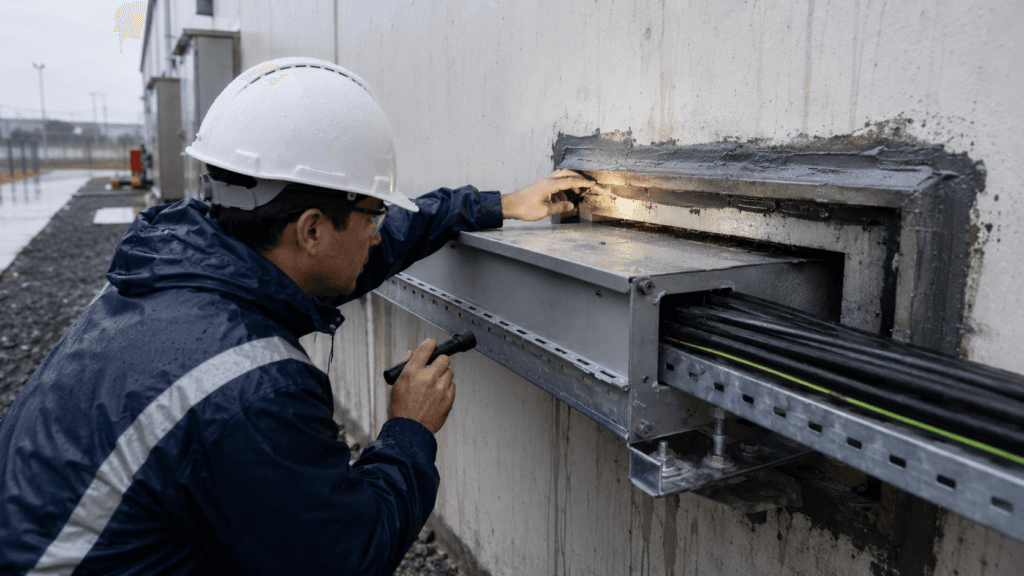
Good air conditioning cannot fully compensate for a room that continuously pulls in hot, humid outdoor air.
The building’s insulation is important, but the weak points are often the openings through the walls.
In electrical facilities, those openings are everywhere.
Busducts pass through exterior walls.
Cable trays enter from outdoor areas.
Cable ducts and conduit banks connect rooms to the field.
Pipes and ventilation openings penetrate walls and roofs.
If these penetrations are poorly sealed, humid outdoor air can enter directly into the room.
I have learned not to judge the room only by its walls and doors.
I also check:
- Busduct wall penetrations
- Cable-tray openings
- Cable-duct entries
- Unused conduit openings
- Gaps around louvers and dampers
- Door seals
- Ceiling and roof penetrations
- Areas where insulation has been removed for previous maintenance
A penetration may look small compared with the size of the room.
But if humid air enters continuously, the air-conditioning system must fight that load all day.
This becomes especially important when the incoming air reaches cold metal surfaces.
That is where condensation can begin.
Be Careful About Making the Room Too Cold
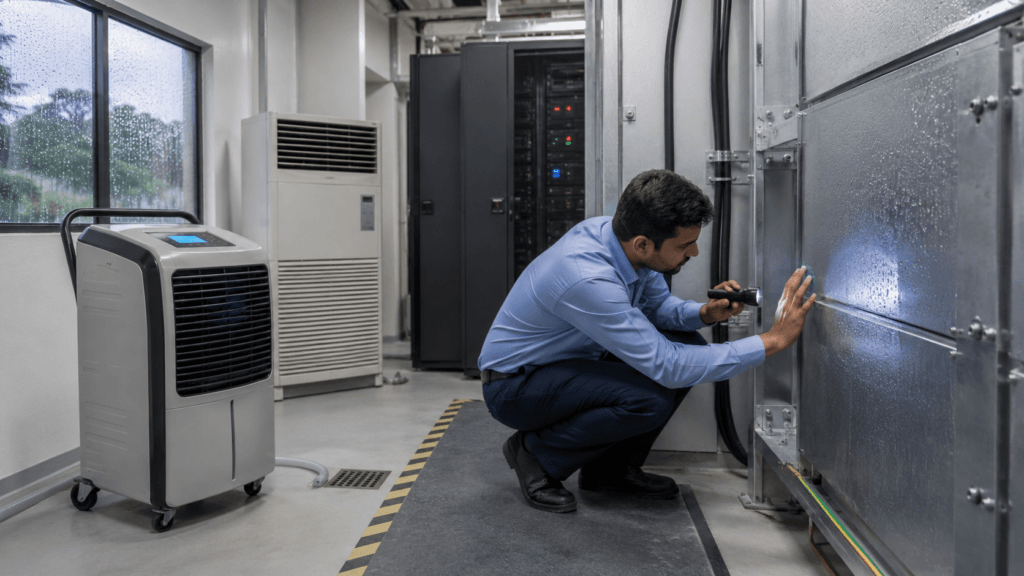
When humidity rises, the natural reaction is often to lower the temperature setting.
A colder room feels safer.
It also feels more comfortable for people working inside.
But during hot and humid weather, excessive cooling can create another problem.
Condensation.
If metal equipment surfaces become colder than the dew point of the surrounding air, moisture can form on those surfaces.
This can happen on:
- Busduct enclosures
- Cable glands
- Metal panels
- Air-conditioning ducts
- Pipes
- Cable-tray supports
- Equipment near outdoor wall penetrations
The risk becomes greater when humid outdoor air enters a heavily cooled room.
The air conditioner may keep the room cold, but the leaking outdoor air still carries a large amount of moisture.
When that moisture meets a cold surface, the result can be water inside a room designed to protect electrical equipment.
For this reason, I do not try to keep an electrical room as cold as possible.
The goal is stable and appropriate temperature and humidity control—not maximum cooling.
Temperature, humidity, air leakage, and surface temperature must be considered together.
A cold room is not automatically a dry room.
Practical Options When Major Improvements Must Wait
The best solution may be to upgrade the HVAC system, improve the building insulation, or properly reseal every penetration.
But those projects require time, budget, design review, and sometimes a shutdown.
When major work cannot be done immediately, smaller measures can still make a meaningful difference.
Industrial Dehumidifiers
Industrial dehumidifiers are much better than they used to be.
A properly sized unit can significantly reduce humidity in a problem area.
But I do not simply place one in the room and assume the issue is solved.
I check:
- Rated dehumidification capacity
- Actual room volume
- Continuous drainage arrangement
- Drain blockage risk
- Filter cleaning
- Additional heat released into the room
- Whether the unit can operate continuously and reliably
A dehumidifier removes moisture, but it also releases heat.
The air-conditioning system must be able to handle that extra heat load.
Additional Small Air-Conditioning Units
A small additional air-conditioning unit can also provide noticeable improvement without replacing the entire HVAC system.
This can be useful for a local hot area or a room where the existing system has little spare capacity.
The installation still needs attention.
The hot exhaust air must not return to the same room.
Condensate must be drained safely.
The unit should not blow cold air directly onto electrical equipment in a way that creates local surface cooling and condensation.
Reducing Unnecessary VFD Heat
VFDs also add heat to the room.
Where a fan or pump operates near maximum speed throughout the summer, it may be worth reviewing whether VFD operation is still necessary during that period.
For example, HVAC fans or cooling-tower fans may run close to full speed for long periods during peak summer conditions.
If the system was designed with a proper bypass or fixed-speed operating mode, operating outside the VFD may reduce some heat losses inside the electrical room.
This is not a blanket recommendation to bypass every VFD.
The motor, protection system, starting method, process requirements, and equipment design must support it.
But it is a useful question to ask:
If the drive is operating at full speed all day, is it still providing enough control benefit to justify the additional room heat?
Sometimes a small operational change can reduce the cooling load until a more permanent improvement is available.
My Rainy-Season Walkthrough
During the rainy season, I prefer a short but repeated inspection rather than relying only on one daily reading.
My walkthrough usually includes the following.
Temperature and Humidity
I compare current readings with previous days rather than looking only at whether the value is below an alarm limit.
A slow trend upward often tells more than one isolated number.
Air-Conditioning Operation
I check whether all units are running normally, whether airflow feels reduced, and whether condensate is draining properly.
Outdoor-Air Entry Points
I look at doors, busduct penetrations, cable trays, ducts, and previously repaired wall openings.
Cold Metal Surfaces
I check for sweating, water marks, corrosion, or moisture around busducts, ducts, panels, pipes, and cable entries.
Equipment Heat
High room humidity and abnormal equipment heat can become a bad combination.
I pay attention to VFDs, UPS systems, power supplies, transformers, and heavily loaded panels.
Dehumidifier Condition
If dehumidifiers are installed, I check the drain, filter, operating status, and whether the room temperature has increased.
Recent Changes
I ask whether a door has been left open, maintenance work has disturbed a wall seal, an air-conditioning unit has been stopped, or new equipment has been added.
These checks are simple.
The value comes from doing them consistently and noticing when the room begins to behave differently from normal.
A Small Field Checklist
Before and during the rainy season, I like to confirm:
- HVAC capacity is sufficient for the internal heat load
- Air-conditioning filters and condensate drains are clean
- Temperature and humidity trends are being recorded
- Outdoor conditions are considered
- Busduct and cable penetrations are properly sealed
- Door seals and unused openings are checked
- Industrial dehumidifiers have reliable drainage
- Temporary air conditioners discharge heat outside the room
- Cold surfaces are checked for condensation
- VFD and UPS heat loads are considered
- Recent construction or maintenance openings are resealed
- The room is not being cooled excessively
- Abnormal conditions are verified several times during the day
Final Thought
During the rainy season, I become more cautious around electrical rooms.
Not because a failure is happening every day.
Because the conditions for a failure can quietly build while everything still appears normal.
The air conditioner is running.
The room feels cool.
The equipment is operating.
But humid air may be entering through a penetration.
Moisture may be collecting on a cold surface.
The room may be slowly losing its humidity-control margin.
Good electrical-room management is not only about keeping the equipment cool.
It is about keeping the environment stable, dry, and predictable.
And sometimes, the safest room is not the coldest one.
It is the room where heat, humidity, airflow, and condensation risk are kept in balance.