
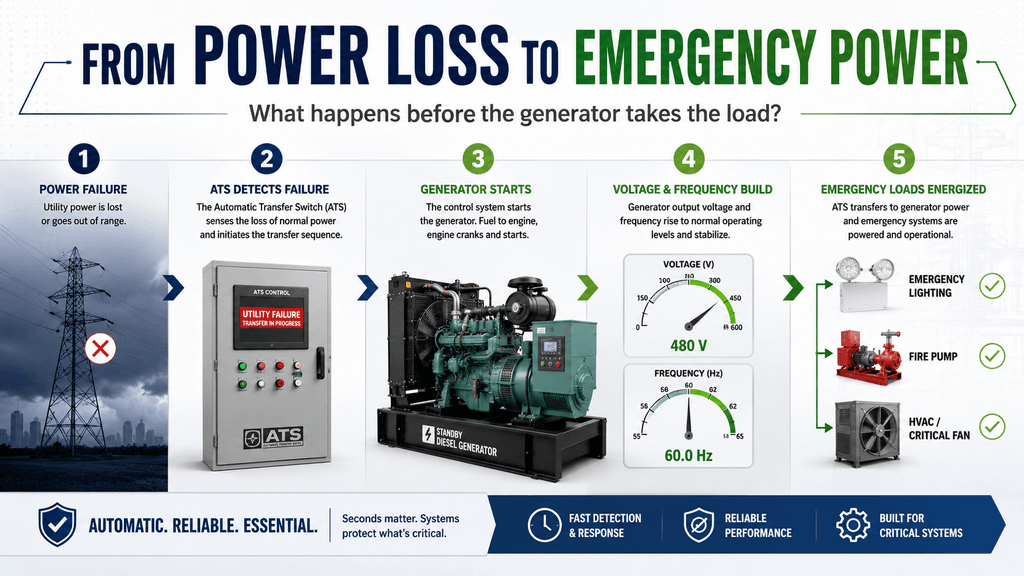
When normal power disappears, emergency generator power does not appear instantly.
There is a short sequence of events between the two.
Understanding that sequence helps explain why emergency loads may stay de-energized for several seconds after a power failure.
1. Normal Power Is Lost
The first event is simple.
The normal utility or incoming power source disappears, or its voltage falls below an acceptable level.
At this moment, the emergency system has to decide:
Is this a temporary voltage dip, or is the normal source really gone?
The system does not necessarily start transferring equipment the instant voltage moves slightly.
Some delay may be intentionally built into the control logic to avoid unnecessary generator starts.
2. The ATS Detects the Power Failure
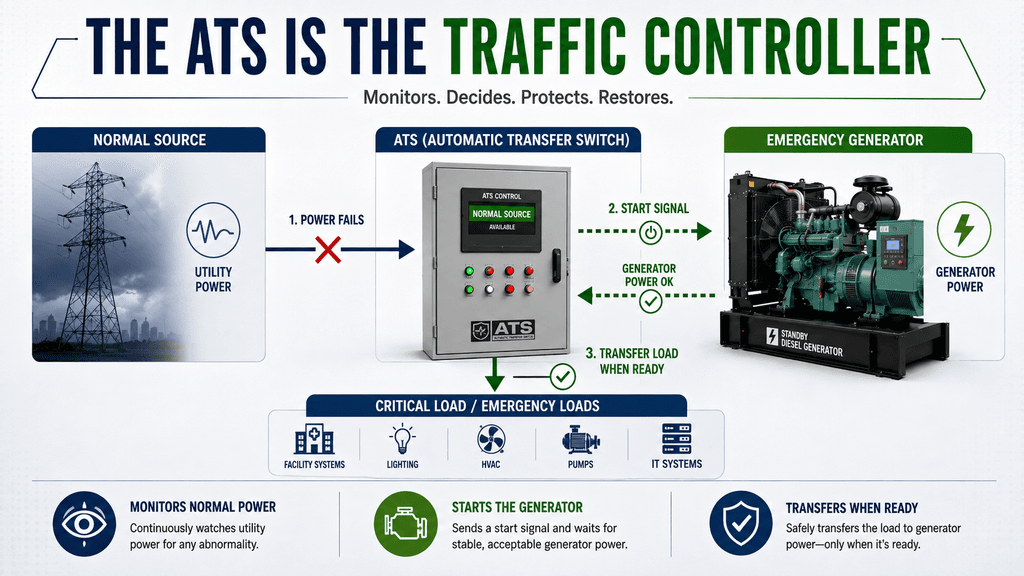
The Automatic Transfer Switch, or ATS, monitors the normal source.
When the normal source is judged unacceptable, the ATS or associated control system sends a start signal to the emergency generator.
At this point, however, the emergency load is still without generator power.
The generator has only been told:
Start.
3. The Generator Engine Cranks
The starting system turns the engine.
Fuel is supplied.
The engine starts and accelerates toward its rated speed.
This is one reason the emergency generator cannot provide power instantaneously.
Unlike a battery or UPS, a generator contains a mechanical prime mover that physically has to start and reach operating speed.
4. Voltage and Frequency Build Up
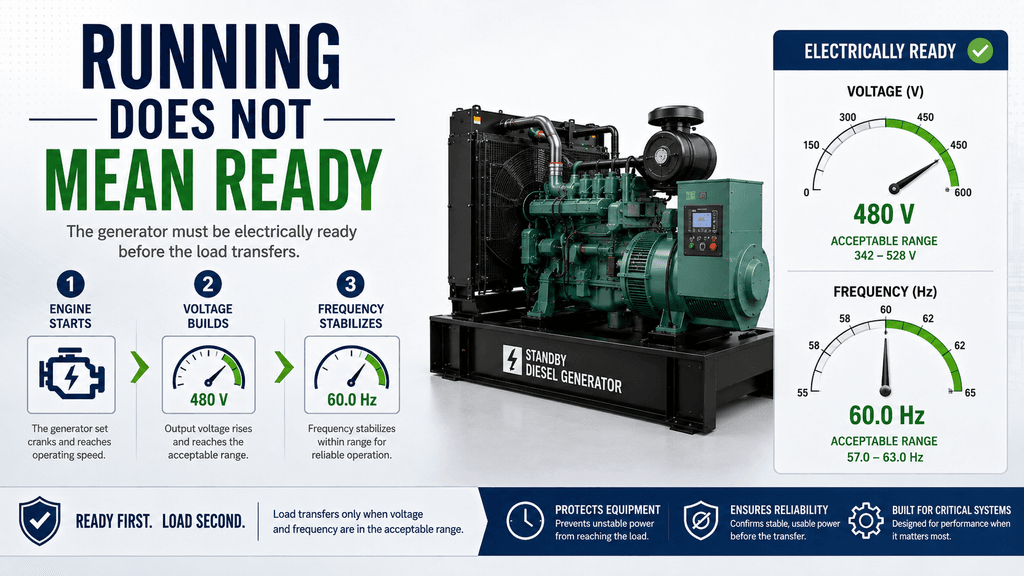
Starting the engine is not enough.
The generator must also produce acceptable electrical output.
The system waits until generator voltage and frequency are within the required range.
Only then can the generator be considered a usable power source.
So:
Generator running ≠ Generator ready to supply the load.
That distinction is important.
5. The ATS Transfers the Load
Once the generator source is confirmed as acceptable, the ATS transfers the emergency load from the normal source to the generator source.
Depending on the system, this may involve opening the normal source connection first and then closing the emergency source connection.
Now the emergency switchboard or emergency loads receive generator power.
The lights come back on.
Emergency equipment starts operating.
From the user’s point of view, this is the moment when:
“The generator came on.”
But several events have already happened before that moment.
The Sequence Is Simple
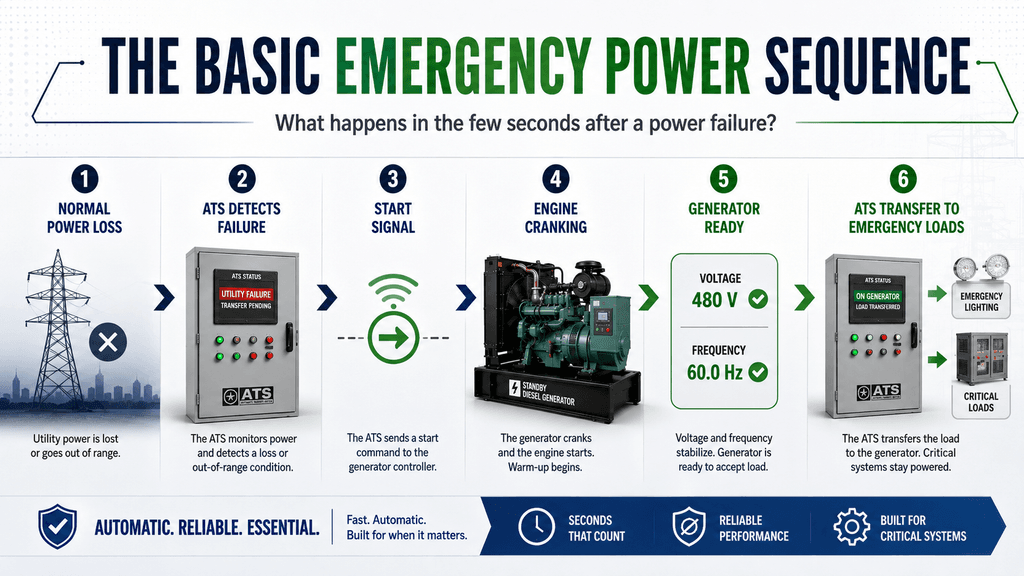
The basic sequence looks like this:
Normal Power Failure
↓
ATS Detects Unacceptable Source
↓
Generator Start Signal
↓
Engine Cranking and Starting
↓
Voltage & Frequency Build-Up
↓
Generator Source Confirmed
↓
ATS Transfer
↓
Emergency Loads Energized
This entire sequence takes time.
That is why there is normally a short interruption between loss of normal power and restoration of emergency generator power.
So What Covers the Gap?
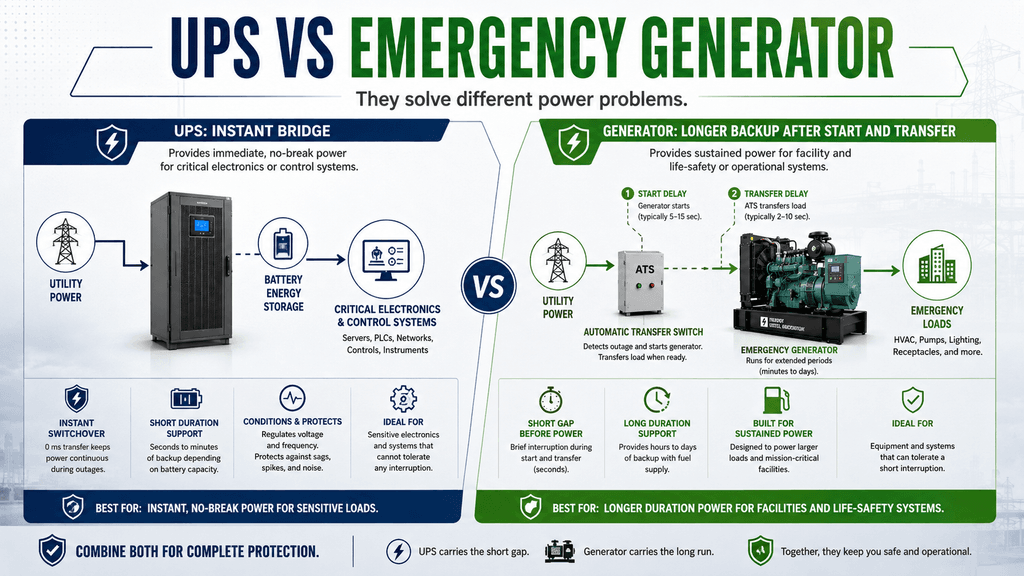
This is where another system may become important.
A generator provides backup power for longer interruptions, but it normally cannot eliminate the short interruption during starting and transfer.
Loads that cannot tolerate even that short interruption may need another source, such as a UPS.
That gives us a simple distinction:
UPS: Bridges the immediate power interruption.
Emergency Generator: Provides longer-duration backup power after starting and transfer.
The two systems solve different problems.
What Electrical Engineers Should Check
When reviewing an emergency power system, I like to think through the sequence rather than looking only at the generator rating.
Ask:
- What detects the normal power failure?
- What sends the generator start signal?
- How is generator availability confirmed?
- What equipment performs the transfer?
- Which loads receive emergency power?
- Which loads cannot tolerate the transfer delay?
These are simple questions, but they help you understand how the entire emergency power system actually works.
The Generator Is Only One Part of the System
A common mistake is to think:
“We have an emergency generator, so we have emergency power.”
But the generator alone is not enough.
The complete system depends on several parts working together:
Source monitoring + starting system + generator + controls + ATS + emergency distribution
If any part of that sequence fails, a perfectly healthy generator may still fail to deliver power to the load.
That is why emergency power should be understood as a system, not just a generator.
Field Checklist
When reviewing an emergency generator system:
□ Confirm how loss of normal power is detected
□ Confirm the generator start signal path
□ Check that generator voltage and frequency are verified before transfer
□ Identify the ATS or transfer equipment
□ Confirm which loads are connected to emergency power
□ Identify loads that cannot tolerate the generator transfer delay
□ Verify the complete sequence during periodic testing
Safety Note:
Emergency generator and transfer systems must be operated, tested, and maintained according to the approved design, manufacturer instructions, applicable electrical standards, and site procedures. Switching and testing should only be performed by authorized personnel.