
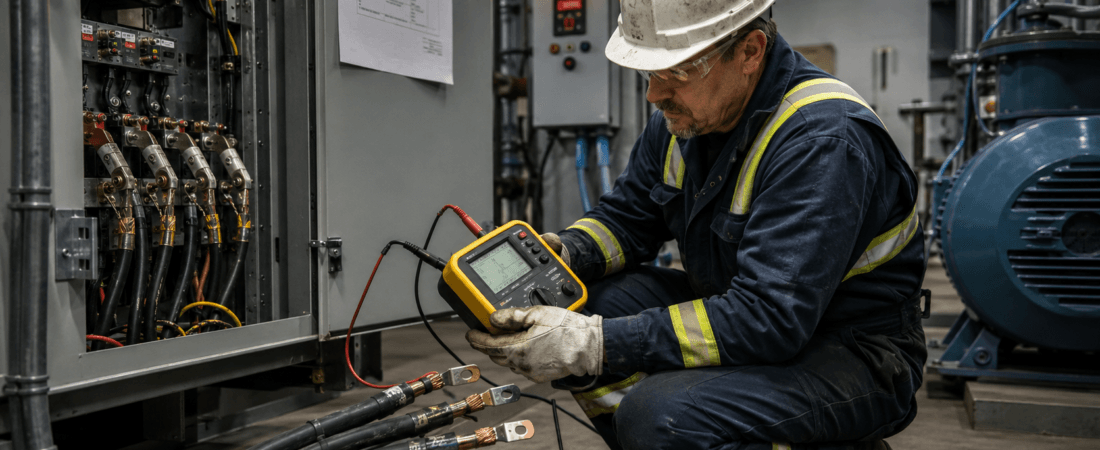

A motor feeder trips after several minutes of operation.
The cable is disconnected and tested.
Phase to phase: good.
Phase to ground: good.
The insulation resistance is well above the expected minimum.
The circuit is energized again.
Ten minutes later, it trips.
At this point, the cable is often removed from the suspect list.
That can be a mistake.
A good insulation resistance reading does not prove that a cable will remain healthy under heat, vibration, load current, and operating voltage stress.
It proves that the cable passed one test, under one set of conditions, at that moment.
The Test Was Not Wrong
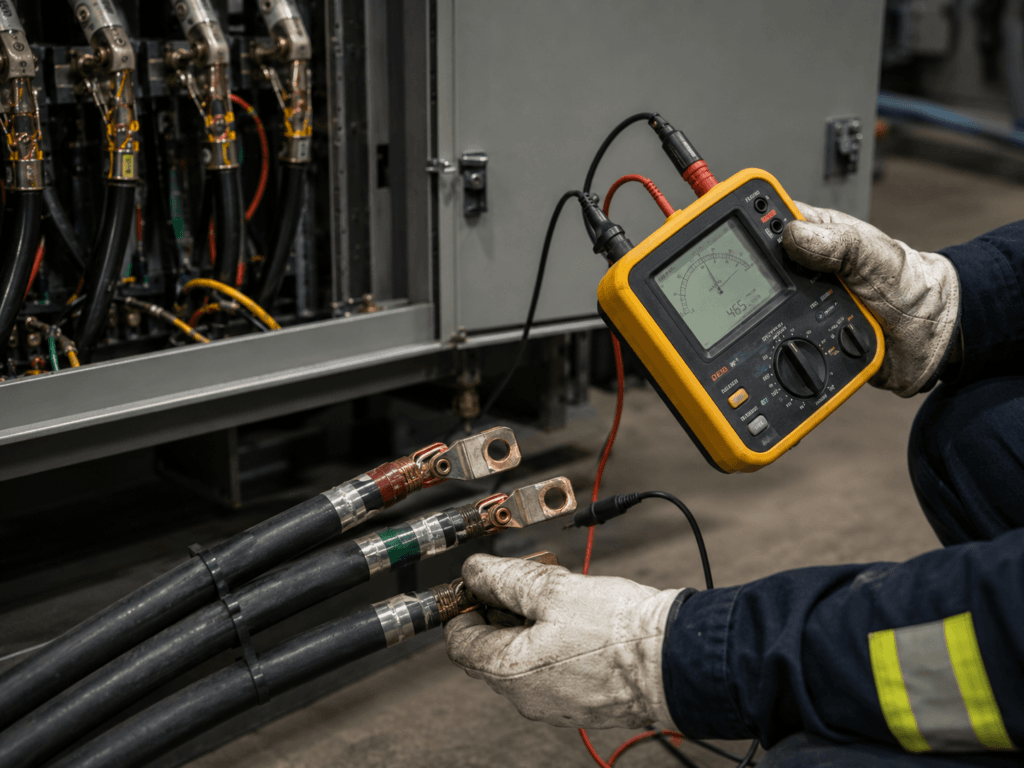
An insulation resistance test is useful.
It can identify:
- Severe insulation deterioration
- Moisture contamination
- Ground faults
- Damaged insulation
- Incorrectly connected conductors
But the test is normally performed while the circuit is:
- De-energized
- Disconnected
- Relatively cool
- Free from load current
- Free from normal vibration
- Not exposed to switching transients
The operating environment is different.
A cable that looks healthy while isolated may behave differently after it heats up or begins moving with the equipment.
The problem may also be at the termination rather than inside the cable itself.
What a Megger Test May Not Reveal
1. A High-Resistance Connection
A loose or oxidized termination can pass an insulation resistance test easily.
The insulation between the conductor and ground may be perfectly healthy.
The real problem is resistance in the current path.
Once load current flows, the connection begins to heat.
The heat increases resistance, and the rising resistance creates more heat.
Possible signs include:
- Discolored lugs
- Melted insulation near the terminal
- Unequal phase temperatures
- Voltage drop across a connection
- A trip that occurs only after several minutes
An insulation resistance test does not measure this type of series resistance.
2. A Temperature-Dependent Insulation Defect
Some insulation defects appear only after the cable warms up.
Expansion can open a crack, change the position of damaged insulation, or allow moisture to move within a termination.
The cable may test well in the morning and fail after the equipment has been operating.
The timing of the fault matters.
An immediate trip and a trip after twenty minutes are not the same failure pattern.
3. An Intermittent Conductor Problem

A conductor can be partially broken near:
- A cable gland
- A sharp bend
- A vibrating motor
- A movable machine
- A poorly supported termination
When the cable is stationary, continuity may appear normal.
During operation, vibration or thermal expansion can interrupt the conductor or create arcing.
The fault may disappear again before the circuit is tested.
4. Moisture That Appears Under Operating Conditions
Water does not always enter a cable or junction box in an obvious way.
It may collect through:
- Condensation
- Damaged cable glands
- Poor drain arrangements
- Underground conduits
- Temperature cycling
- Rainwater following the cable path
A dry cable can pass the test.
The same cable may fail when humidity increases or moisture reaches a damaged termination.
5. VFD Output Stress

A motor cable supplied by a VFD does not experience the same electrical conditions as a cable connected directly to a sinusoidal power source.
Fast voltage rise times, reflected waves, and common-mode voltage can stress:
- Cable insulation
- Motor winding insulation
- Shield terminations
- Grounding connections
A DC insulation resistance test does not reproduce those operating conditions.
A good megger result therefore should not automatically remove the cable, termination, or motor insulation system from the investigation.
What to Check Next
When a cable passes the insulation resistance test but the fault returns under load, I would not repeat the same test five times and expect a different answer.
I would change the test conditions and divide the circuit.
Check the Failure Timing
Record whether the fault occurs:
- Immediately after starting
- During acceleration
- At a specific load
- After the cable becomes warm
- During rain or high humidity
- When the equipment begins vibrating
The time pattern often tells more than the first resistance reading.
Compare All Three Phases
Check for differences in:
- Load current
- Phase voltage
- Terminal temperature
- Conductor resistance
- Voltage drop
A single abnormal phase can point toward a damaged conductor, weak termination, fuse holder, contactor pole, or cable joint.
Inspect the Entire Current Path
Do not inspect only the visible cable body.
Check:
- Breaker terminals
- Contactor terminals
- Fuse holders
- Cable lugs
- Junction boxes
- Glands
- Motor terminal boxes
- Ground and shield connections
The cable may be blamed for a fault that is actually located several centimeters away from it.
Test Hot and Cold Conditions
When the procedure can be performed safely, compare measurements before operation and after the fault occurs.
A large change between cold and warm conditions is valuable evidence.
Always isolate the circuit, verify absence of voltage, and discharge the cable before touching or reconnecting it.
Divide the Circuit
Separate the motor, cable, and starter section where practical.
A temporary known-good cable, a controlled motor test, or section-by-section isolation can help determine where the fault remains.
The objective is not to prove the first theory.
The objective is to make the fault follow one part of the circuit.
Field Checklist
Before declaring the cable healthy, ask:
- Did the test represent the actual operating condition?
- Does the fault appear only after warm-up?
- Are all three phase currents balanced?
- Is there an abnormal terminal temperature?
- Is there measurable voltage drop across a connection?
- Does vibration, movement, rain, or humidity affect the fault?
- Were the motor and cable tested separately?
- Could the problem be at the termination rather than in the insulation?
Final Thought
A megger reading is evidence.
It is not a verdict.
The most dangerous troubleshooting mistake is not using the wrong instrument.
It is asking the right instrument to answer a question it was never designed to answer.
When a cable passes the test but fails in operation, stop repeating the static test.
Start investigating what changes when the load is applied.