
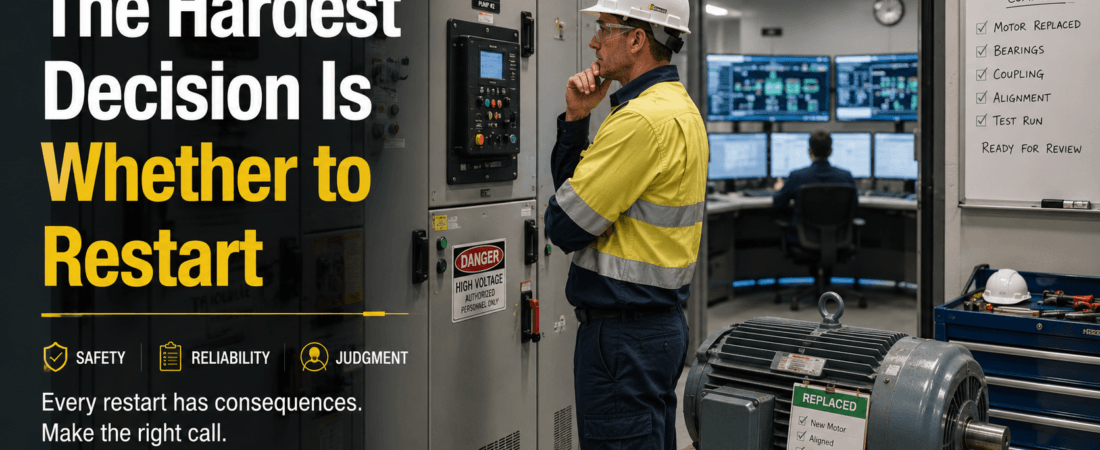
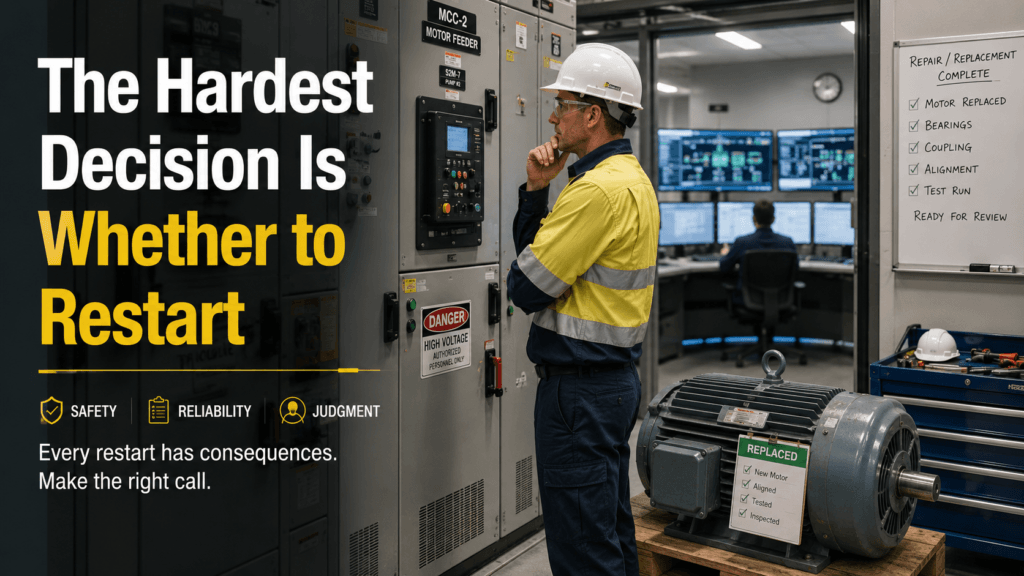
The failed motor had been replaced.
The insulation resistance was acceptable.
The breaker was ready to close.
Then the operator asked:
“Can we restart now?”
That is often the hardest question after an electrical failure.
Finding a damaged component may be straightforward. Replacing it may also be straightforward.
Deciding whether the system is safe to run again is different.
The cause may not be fully confirmed.
Production pressure is increasing.
And the engineer must make a decision with incomplete information.
Repair Complete Does Not Mean Risk Removed
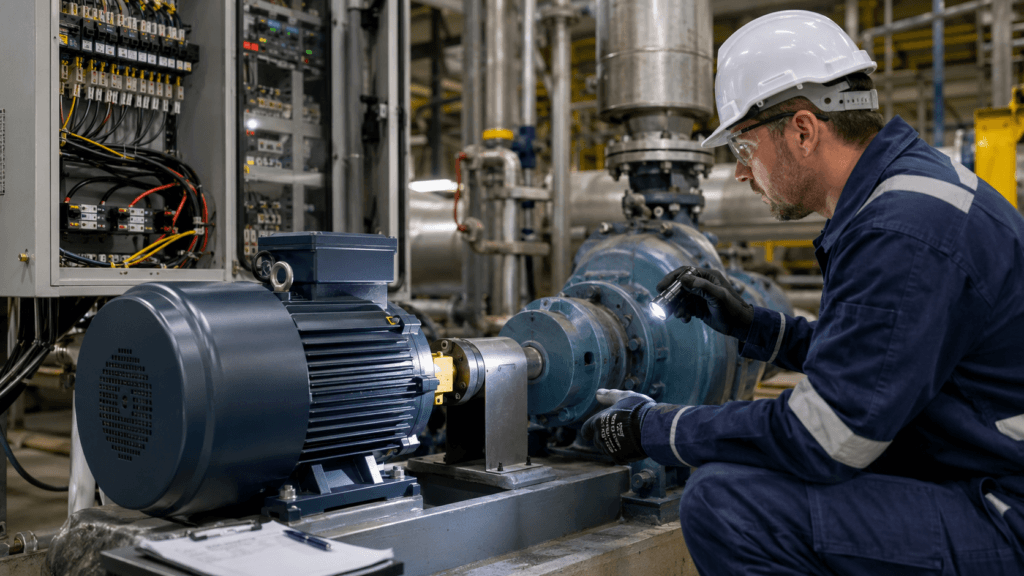
A damaged component is sometimes the result, not the cause.
A motor may fail because of:
- Mechanical locking
- Repeated overload
- Phase imbalance
- Poor terminal connections
- Cooling failure
- Incorrect protection settings
- Process conditions outside the original design
Replacing the motor removes the damaged motor.
It does not automatically remove the condition that damaged it.
Before restarting, I ask:
What changed between the moment before the failure and now?
If the answer is only “the failed part was replaced,” the investigation may not be finished.
I Separate Three Questions
Before supporting a restart, I try to answer three questions.
1. Why Did the Equipment Stop?
Was the trip caused by a genuine electrical fault?
Did the protection operate correctly?
Was there evidence of overload, ground fault, short circuit, phase loss, or mechanical seizure?
A reset without understanding the trip is not a diagnosis.
2. Has the Immediate Cause Been Removed?
If a motor failed because the driven equipment was locked, replacing only the motor does not make the system ready.
If a cable terminal overheated because of poor contact pressure, cleaning the surface without correcting the connection may not be enough.
I want to know what physical or operational condition changed.
3. What Happens If We Are Wrong?
This is the most important question.
If the restart fails, will the result be:
- Another controlled trip
- Further equipment damage
- A main breaker outage
- Fire or arc damage
- Process instability
- Risk to personnel
The possible consequence determines how much evidence I need before restarting.
Not every failure requires the same level of caution.
A Restart Can Be a Controlled Test
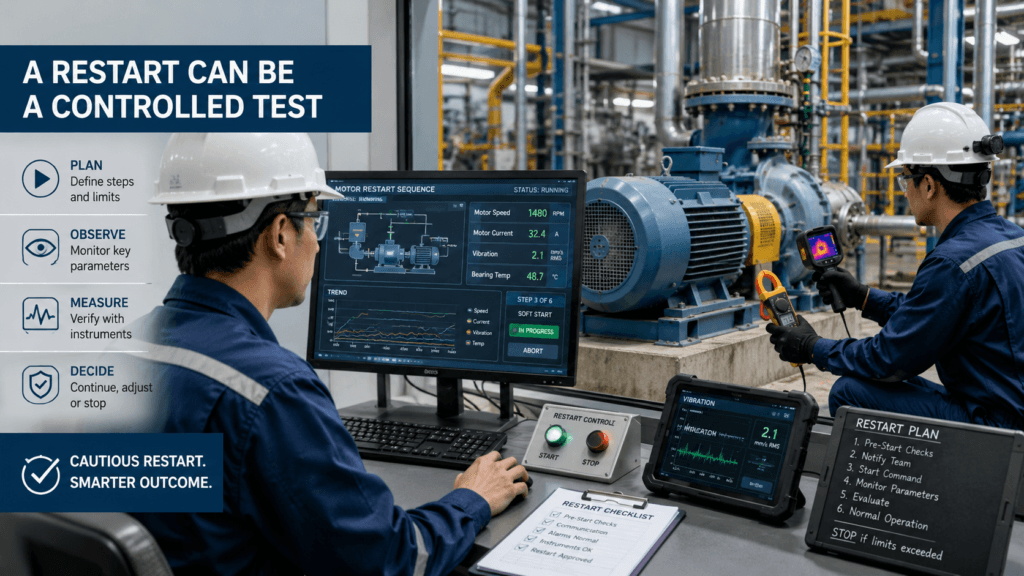
Sometimes the cause cannot be confirmed with complete certainty before operation resumes.
That is normal in real plants.
In that case, restart should not mean:
“Everything looks fine. Let us try again.”
It should be treated as a controlled test.
Before starting, I want clear agreement on:
- Who will operate the equipment
- Who will observe it in the field
- Which values will be monitored
- What condition requires an immediate stop
- How the equipment will be isolated if the problem returns
Depending on the equipment, I may monitor:
- Starting and running current
- Current imbalance
- Voltage
- Vibration and sound
- Bearing and terminal temperature
- Process load
- Protection relay records
- Smell, smoke, or abnormal heating
A restart without monitoring only tells us whether the equipment survived the first few seconds.
A controlled restart gives us information.
Production Pressure Changes the Conversation
When production is stopped, every minute matters.
That pressure is real and should not be ignored.
But urgency can change the way people speak.
“Can we restart?” quickly becomes:
“Nothing looks wrong now.”
Then:
“We already replaced the motor.”
And finally:
“Let us run it and see.”
This is where an engineer must slow the conversation down just enough to make the remaining risk visible.
The goal is not to delay production unnecessarily.
The goal is to prevent a small failure from returning as a larger one.
A ten-minute check can feel expensive during an outage.
It feels much cheaper after avoiding another trip.
My Minimum Restart Check
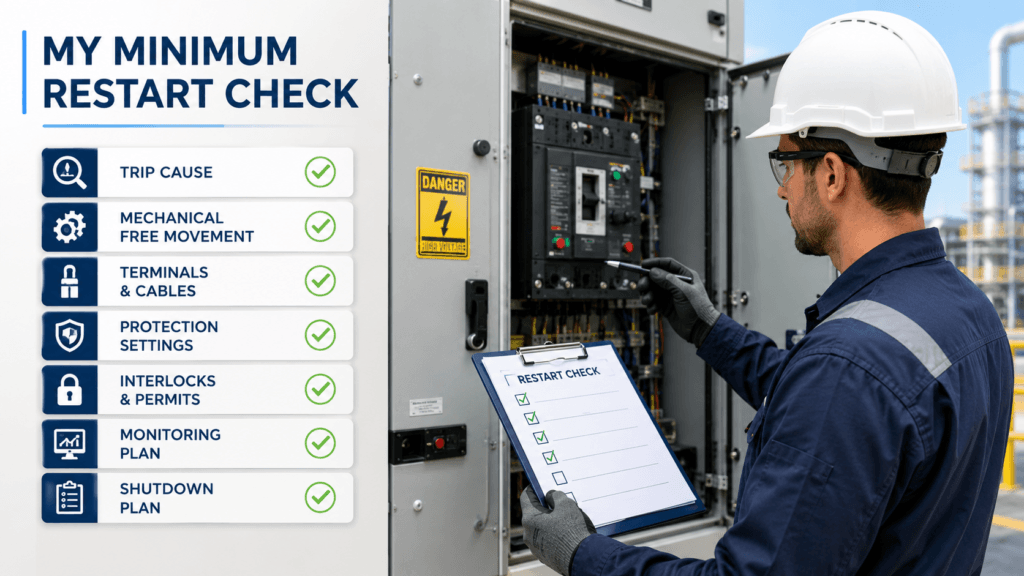
The exact checks depend on the equipment, but I usually want these points addressed:
- The trip cause has been reviewed
- The failed component has been inspected, not only replaced
- The connected mechanical equipment can move normally
- Power cables and terminals show no secondary damage
- Protection settings are appropriate and active
- Relevant interlocks and permissives are available
- The expected starting current and duration are understood
- A monitoring and shutdown plan is agreed
- The restart decision and remaining concerns are recorded
This is not a guarantee that nothing will go wrong.
It is evidence that the decision was made deliberately.
The Real Engineering Decision
Engineers rarely receive perfect information during a plant outage.
Waiting for complete certainty may be impossible.
Restarting without understanding the risk is also unacceptable.
The practical decision is therefore not:
“Do we know everything?”
It is:
“Do we understand the remaining risk well enough to control it?”
That is the line I try to find.
Final Thought
A successful repair does not automatically mean a safe restart.
The equipment may be ready to run.
The system may not yet be ready to trust.
Before closing the breaker, I want to know three things:
Why did it stop?
What has actually changed?
And what will happen if we are wrong?
Because the hardest question after a failure is often not:
“What should we repair?”
It is: