
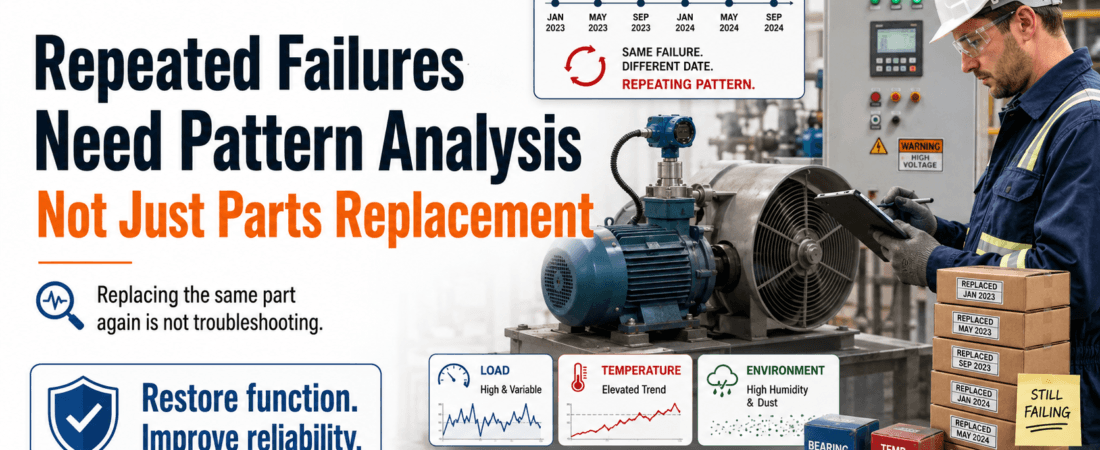
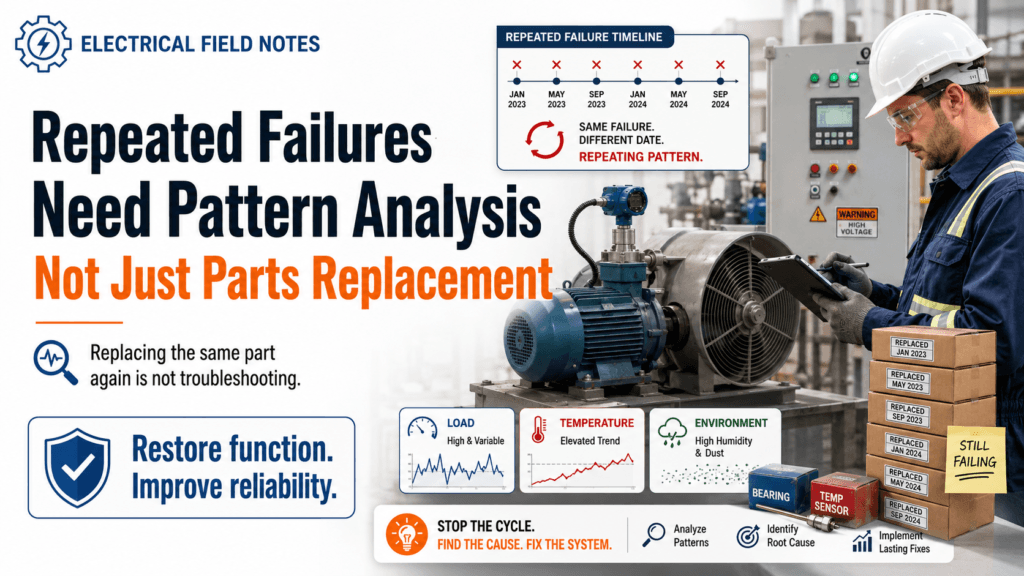
Replacing the same part again is not troubleshooting.
It may restore the equipment.
It may restart production.
It may clear the alarm and make the maintenance report look complete.
But if the same failure returns, the replacement did not solve the real problem.
It only reset the clock.
In the field, this is one of the most frustrating maintenance situations.
A motor fails and is replaced.
A sensor becomes unstable and is replaced.
A relay trips repeatedly and is replaced.
A cooling fan burns out and is replaced.
Then, after a few weeks or months, the same problem comes back.
At that point, the failed part is no longer the only issue.
The repeated pattern itself has become the most important evidence.
A Repeated Failure Is Different from a Single Failure
A single component can fail for many ordinary reasons.
Manufacturing defects happen.
Components age.
Insulation deteriorates.
Contacts wear out.
Bearings reach the end of their service life.
But when similar failures happen repeatedly on the same equipment, under similar conditions, or at similar intervals, the probability of a random component failure becomes lower.
The system may be creating the failure.
The real cause may be:
- Excessive load
- Frequent starts and stops
- Poor ventilation
- High ambient temperature
- Moisture or contamination
- Voltage imbalance
- Misalignment or vibration
- Incorrect protection settings
- Poor cable termination
- Process instability
- Incorrect operation
- Maintenance-induced problems
- An unsuitable component specification
The failed component may be the weakest point.
But the weakest point is not always the root cause.
Replacement Restores Function, Not Necessarily Reliability
There is an important difference between restoring function and restoring reliability.
Replacing a failed part can make the equipment run again.
That is functional recovery.
But reliability means the equipment can continue operating without the same failure returning.
Those are not the same result.
In production environments, rapid restoration is often necessary. The plant cannot always wait for a complete root cause investigation before restarting equipment.
I understand that pressure.
Sometimes the correct immediate action is to install the spare part, test the equipment, and return it to service.
But there should be a second action.
The failed part should be preserved.
The operating conditions should be recorded.
The failure history should be reviewed.
The team should decide whether further investigation is required.
Without that second step, emergency replacement quietly becomes the final conclusion.
That is where repeated failures begin to look normal.
The Same Failed Part May Be Only the Final Victim
When the same component fails repeatedly, it is natural to focus on that component.
But consider a motor cooling fan that repeatedly burns out.
The fan may be defective.
Or the actual problem may be:
- High enclosure temperature
- Blocked ventilation openings
- Dust accumulation
- Incorrect supply voltage
- Continuous operation beyond its duty
- Hot air recirculation
- Nearby heat sources
- Bearing drag
- Reverse airflow from another fan
The fan is where the failure becomes visible.
But the surrounding condition may be what keeps producing the failure.
The same logic applies to many maintenance problems.
A damaged terminal may be the result of loose torque or poor crimping.
A failed bearing may be the result of misalignment or shaft current.
A transmitter fault may be caused by impulse-line blockage or moisture ingress.
A VFD trip may be caused by load instability or motor condition.
A breaker trip may be the final response to poor downstream protection.
The failed component tells us where the system lost its margin.
It does not always tell us why.
Look for Patterns Before Looking for Another Spare
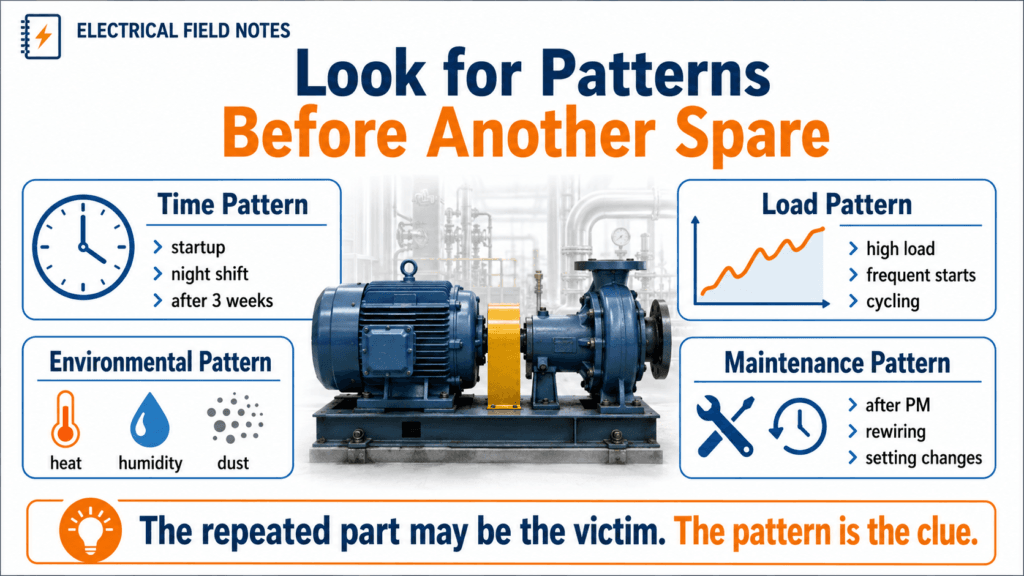
When a failure repeats, I prefer to organize the investigation around patterns.
Time Pattern
When does the failure happen?
Does it occur:
- After a certain number of operating hours?
- During startup?
- During shutdown?
- After maintenance?
- During night operation?
- At the same time of day?
- After several rapid restarts?
- During seasonal temperature changes?
Time relationships often reveal conditions that are invisible during a normal inspection.
A motor that fails only during frequent restarts may not have a motor-quality problem.
It may have a duty-cycle problem.
Load Pattern
What was the equipment doing when it failed?
Was the load:
- Higher than normal?
- Rapidly changing?
- Mechanically blocked?
- Operating near maximum capacity?
- Starting against pressure or inertia?
- Running under low-flow or dry conditions?
- Cycling more frequently than intended?
A component can be correctly sized for normal operation but repeatedly stressed by abnormal operating conditions.
Environmental Pattern
What was happening around the equipment?
Check for:
- High temperature
- Humidity
- Condensation
- Dust
- Chemical vapors
- Water ingress
- Poor ventilation
- Direct sunlight
- Vibration
- Nearby welding or construction work
Electrical and instrumentation failures often begin as environmental problems.
A clean workshop test may show that the component is healthy.
The field environment may tell a different story.
Maintenance Pattern
What work was performed before the failure appeared?
Was the equipment:
- Rewired?
- Recalibrated?
- Realigned?
- Cleaned?
- Opened for inspection?
- Reassembled with new parts?
- Temporarily bypassed?
- Returned to service with changed settings?
When a fault appears after maintenance, one of my first questions is:
What did we touch?
This is not about blaming the technician.
Maintenance changes the system. Even correct work can reveal hidden weaknesses, disturb aging connections, introduce configuration differences, or leave an overlooked terminal loose.
Recent work is not proof of the cause.
But it is an important clue.
Do Not Assume the Same Symptom Has the Same Cause
There is another trap in repeated-failure troubleshooting.
The symptom may look the same, but the cause may be different.
For example, a motor may trip on three separate occasions.
The first event may be caused by mechanical overload.
The second may be caused by voltage imbalance.
The third may be caused by incorrect EOCR settings.
From the operator’s perspective, all three events may be reported as:
“The motor tripped again.”
That description is not enough.
The exact trip code, fault current, operating condition, event time, load condition, temperature, and recent work history must be recorded.
Repeated symptoms should be compared carefully.
Otherwise, unrelated failures can be grouped together and treated as one problem.
Pattern analysis does not mean forcing every event into the same explanation.
It means comparing evidence before deciding whether the events are truly connected.
Preserve the Evidence Before Resetting Everything
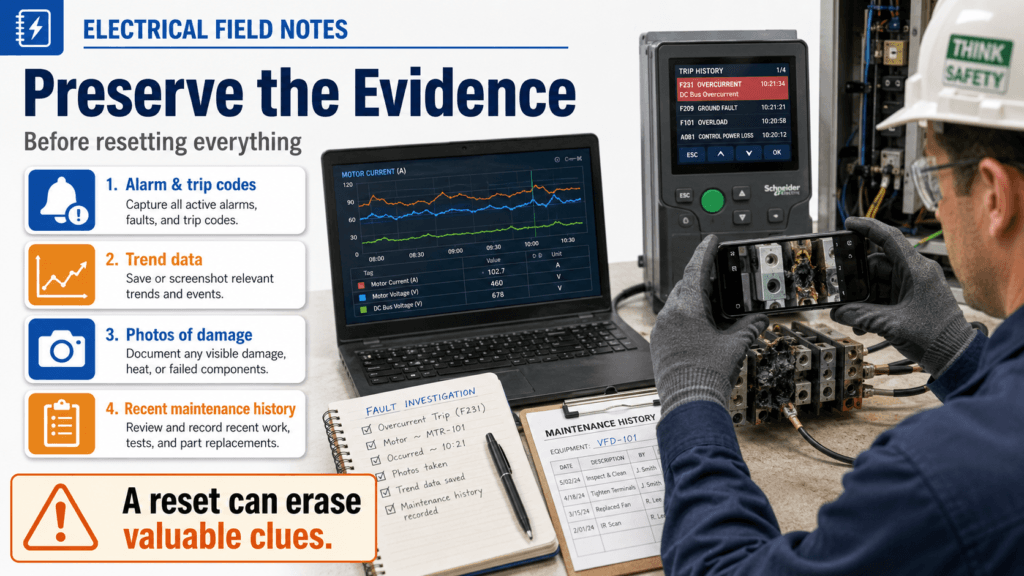
One of the biggest losses during troubleshooting is not equipment damage.
It is lost evidence.
When a fault occurs, the first response is often to reset the alarm, restart the equipment, and clear the area.
That may be necessary for production recovery.
But before resetting, record what you can safely record.
Capture:
- Alarm and trip codes
- Relay event records
- VFD fault history
- PLC/DCS trends
- Operating current
- Voltage condition
- Equipment temperature
- Process condition
- Position of valves and dampers
- Status of interlocks
- Photos of damaged parts
- Condition of terminals and connectors
- Recent maintenance information
A reset can remove valuable information.
A replacement can remove the failed part from its original condition.
Cleaning can remove contamination evidence.
Disassembly can change alignment, wiring position, or contact condition.
The first few minutes after a failure may contain the best evidence available.
A Practical Review Sequence for Repeated Failures
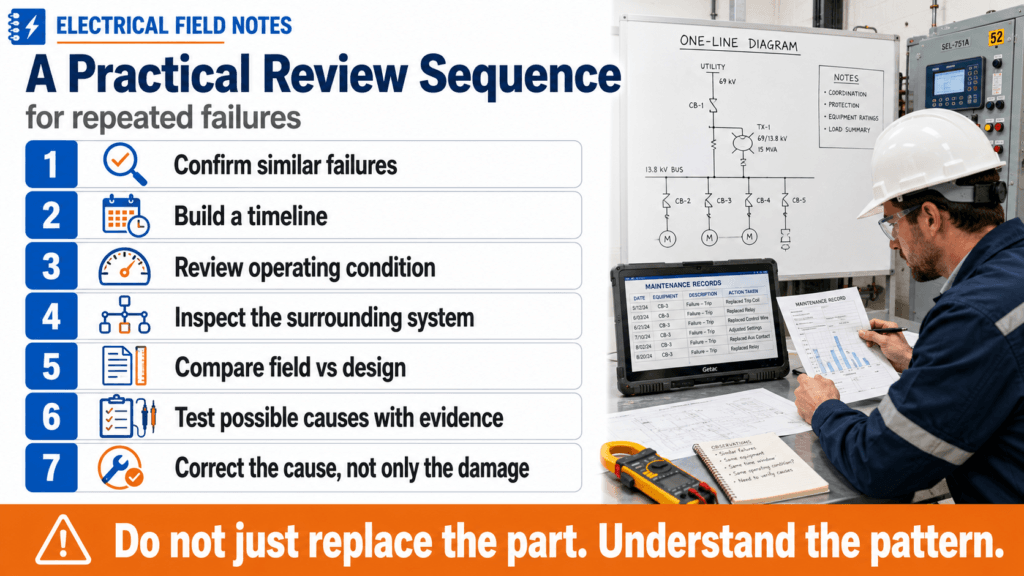
When the same equipment or component fails again, I prefer a structured sequence.
1. Confirm That the Failures Are Actually Similar
Compare the exact failure mode.
Do not rely only on descriptions such as:
- “Motor problem”
- “Sensor fault”
- “Breaker trip”
- “Communication error”
Check whether the alarm code, damaged part, operating condition, and failure signature are truly the same.
2. Build a Simple Failure Timeline
Record:
- Failure date and time
- Operating hours
- Production condition
- Weather or ambient condition
- Load condition
- Recent maintenance
- Replaced component
- Corrective action
- Time until recurrence
A simple timeline can reveal patterns that are difficult to see in individual maintenance reports.
3. Review the Operating Condition
Check whether the equipment is being operated within its intended duty.
Nameplate ratings alone are not enough.
Review:
- Start frequency
- Load profile
- Temperature
- Process demand
- Running duration
- Acceleration and deceleration
- Mechanical resistance
- Power quality
4. Inspect the Surrounding System
Do not stop at the failed part.
Check the power supply, wiring, terminals, grounding, cooling, mechanical installation, process connection, control logic, and protection settings.
The problem may be one layer away from the failed component.
Sometimes it is several layers away.
5. Compare Field Conditions with Design Assumptions
Ask whether the actual installation still matches the original design.
Has the motor size changed?
Has the load increased?
Was the cable replaced?
Was a VFD added?
Was the enclosure modified?
Was the process capacity increased?
Was a temporary repair left permanently?
Equipment often continues operating after the system around it has changed.
Protection settings and maintenance assumptions may remain based on the old condition.
6. Decide What Evidence Would Prove or Disprove Each Cause
Do not create only one favorite theory.
List several possible causes and identify the evidence required for each one.
For example:
- Overload → trend current and process load
- High temperature → enclosure temperature and ventilation condition
- Voltage imbalance → phase voltage and current measurements
- Misalignment → alignment and vibration data
- Moisture ingress → enclosure inspection and environmental history
- Incorrect setting → actual relay configuration versus design basis
This keeps the investigation grounded.
7. Correct the Cause, Not Only the Damage
The final corrective action may include replacement.
But it may also require:
- Changing protection settings
- Improving ventilation
- Correcting alignment
- Rerouting cables
- Improving sealing
- Modifying operating procedures
- Updating control logic
- Reducing start frequency
- Changing the component specification
- Updating drawings and maintenance instructions
A successful repair changes the condition that created the failure.
Maintenance Records Should Help Detect Patterns
Many maintenance records are written only to close the work order.
“Motor replaced.”
“Sensor calibrated.”
“Breaker reset.”
“Fan changed.”
These statements describe the action.
They do not preserve enough information to support future troubleshooting.
A useful maintenance record should answer:
- What failed?
- How did it fail?
- Under what condition?
- What evidence was found?
- What action was taken?
- Was the root cause confirmed?
- What should be checked if it happens again?
This does not require a long report every time.
Even a short structured record can become valuable when the third or fourth failure occurs.
Without consistent records, every repeated failure looks like a new event.
With good records, repeated failures become a visible pattern.
Replacement May Still Be the Correct Decision
The purpose of pattern analysis is not to avoid replacing parts.
Some parts are defective.
Some parts are worn out.
Some components are no longer reliable enough to remain in service.
Replacement may be the safest and most practical decision.
But when the same part fails repeatedly, replacement should be treated as one part of the response, not the entire response.
The better question is not:
“What spare part do we need?”
It is:
“What condition keeps consuming this spare part?”
That question changes maintenance from recovery work into reliability improvement.
Final Thought
A failed part gives us a location.
A repeated failure gives us a pattern.
That pattern may be connected to time, load, temperature, environment, operation, maintenance, installation, or system changes.
Replacing the component may restore the equipment today.
Understanding the pattern is what prevents the same failure tomorrow.
Because in the field, the goal is not only to restart the equipment.
The goal is to stop the failure from returning.