
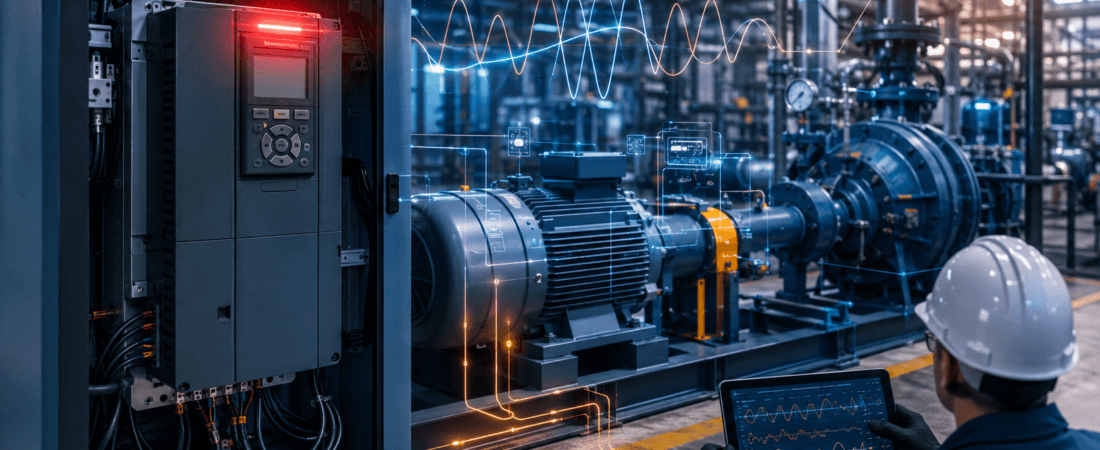

A field note on why VFD faults need system-level diagnosis.
When a VFD keeps faulting, the first suspect is often the VFD itself.
That reaction is natural.
The alarm appears on the drive.
The fault code is displayed on the keypad.
The motor stops because the drive trips.
So it looks like a VFD problem.
But in many field cases, the drive is only reporting the problem.
It is not always the root cause.
A VFD fault is a symptom, not a diagnosis.
Before replacing the drive, engineers should ask a better question:
What is the load asking the VFD to do?
That one question changes the direction of troubleshooting.
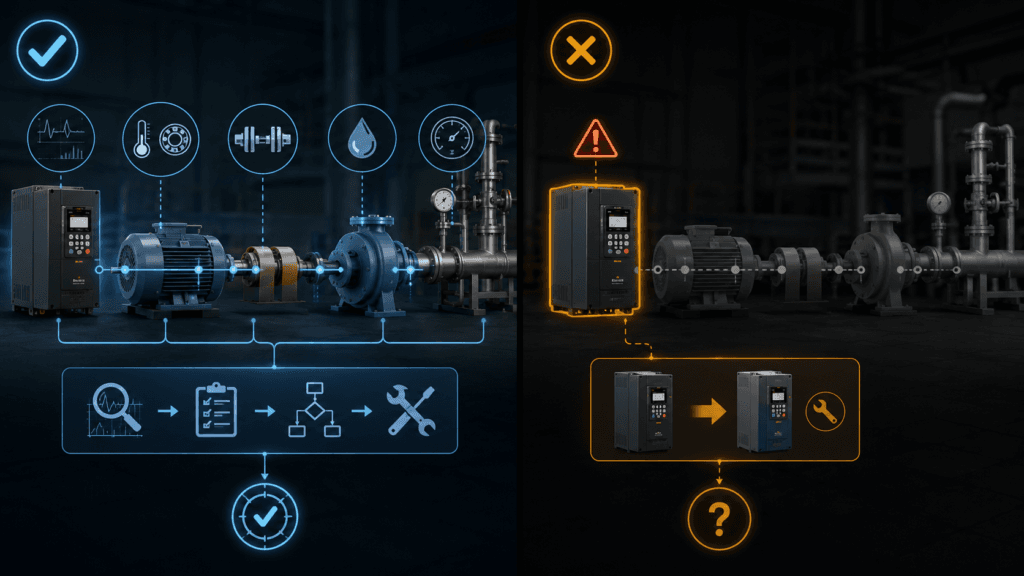
Instead of looking only at the drive, we start looking at the full system: the motor, the load, the acceleration profile, the control mode, the mechanical condition, and the operating sequence.
What happened in the field
In one industrial facility, a motor-driven machine repeatedly faulted during start-up.
The fault did not happen randomly.
It appeared during the acceleration period.
After a reset, the equipment could be started again, but the same fault would eventually return.
At first, the common assumption was simple:
“Maybe the VFD is bad.”
That assumption is understandable.
But a repeated fault at a similar point in the sequence is important information. It tells us that the issue may be related to what the drive is being asked to do at that moment.
In this case, the key issue was not only the VFD.
The key issue was the relationship between the VFD and the load.
The easy wrong answer
Replacing the VFD can feel like the fastest solution.
But if the real issue remains unchanged, a new drive may trip in the same way.
The same load is still there.
The same inertia is still there.
The same acceleration demand is still there.
The same mechanical condition is still there.
If the drive is doing what it is designed to do, replacing it does not solve the problem.
It only replaces the messenger.
A VFD fault should be treated as a starting point for investigation, not as a final conclusion.
Why the load matters
A VFD does not operate alone.
The drive controls the motor.
The motor drives the machine.
The machine interacts with the process.
When the load condition changes, the electrical behavior changes as well.
This is especially important with high-inertia loads.
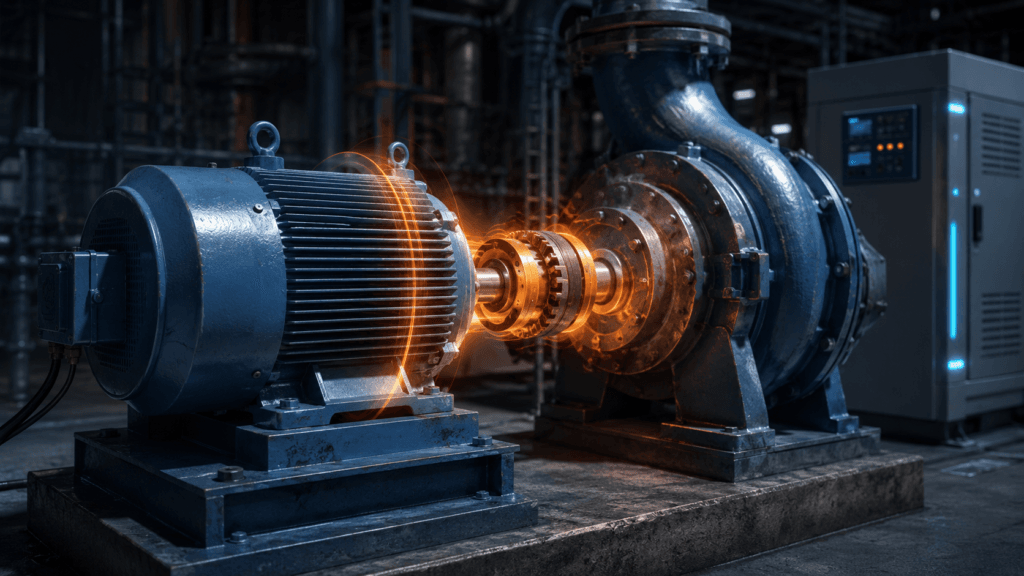
High-inertia loads need more time and torque to accelerate. If the acceleration time is too short, the drive may need to deliver high current to meet the speed command. If the required torque exceeds what the motor and drive can provide, the VFD may reach current limit or trip.
From the outside, this may look like a drive problem.
But the drive may simply be responding to an unrealistic acceleration demand.
Other load-side causes can also create similar symptoms:
- Mechanical binding
- Bearing friction
- Misalignment
- Brake drag
- Partially closed damper or valve
- Product buildup
- High starting load
- Process condition different from design
Any of these can increase torque demand.
When that happens, the VFD is not the source of the problem.
It is the device that exposes the problem.
Acceleration time is not just a parameter
Acceleration time is sometimes treated as a simple tuning value.
But it can directly affect whether the drive trips or runs.
If acceleration time is too short, the drive must increase motor speed quickly. That requires more torque. More torque usually means more current.
If the current stays too high for too long, the VFD may trip.
So the better question is not:
“Can we increase the acceleration time?”
The better question is:
“What acceleration profile matches the real load behavior?”
A good setting is not just a number that avoids trips.
It is a setting that matches the motor, the drive, the load, and the process requirement.
Control mode matters
Control mode is not just a parameter.
It changes how the VFD responds to the load.
V/F control may be enough for many simple fan and pump applications.
Sensorless vector control may provide better torque performance, but it can be more sensitive to motor data and tuning accuracy.
Closed-loop vector control can provide high-performance control, but it requires proper feedback and setup.
The point is not that one mode is always better than another.
The point is that the control mode must match the application.
A parameter change is not a magic fix.
It is a hypothesis.
And that hypothesis must match the actual load behavior.
Fault code alone is not enough
A VFD fault code gives direction.
But it does not give the full diagnosis.
For example, an overcurrent fault may come from:
- Aggressive acceleration
- Mechanical binding
- Incorrect motor data
- Incorrect control mode
- Load jam
- Cable or grounding issue
- Drive output problem
The same fault code can have several different causes.
So the timing of the fault matters.
Useful questions include:
- Does the fault happen during start-up?
- Does it happen at the same speed?
- What was the current before the trip?
- Was the load mechanically free?
- Were any parameters changed?
- Did the process condition change?
A fault code tells us what the drive detected.
The field pattern tells us where to look.
What to check before replacing the VFD

Before replacing a VFD, check these items first.
1. Fault history
Do not look only at the last fault.
Repeated timing and repeated fault codes can reveal a pattern.
2. Load condition
Check whether the driven equipment is mechanically healthy.
Many electrical trips begin as mechanical problems.
3. Acceleration time
Check whether the acceleration profile is realistic for the load.
A high-inertia load may need more time to accelerate.
4. Current trend
Look at the current before the trip.
If current rises sharply or stays high during acceleration, the drive may be struggling with the load.
5. Control mode
Check whether the control mode matches the motor and application.
The most advanced mode is not always the best mode.
6. Motor data
Incorrect motor parameters can cause poor drive behavior.
Check voltage, current, frequency, speed, power, and tuning data.
7. Cable, grounding, and power quality
Long motor cables, poor shielding, grounding issues, voltage imbalance, or unstable input power can also contribute to drive faults.
Field lesson
Do not troubleshoot the VFD alone.
Troubleshoot the system the VFD is trying to control.
A VFD is not only a box with parameters. It is an interface between electrical power, motor behavior, mechanical load, and process operation.
When a drive faults, it may be protecting itself.
It may be protecting the motor.
It may be responding to a mechanical problem.
It may be exposing a poor parameter setting.
The drive is part of the story.
But it is not always the villain.
Final takeaway
Before replacing the drive, understand the load.
Before changing parameters, understand the fault pattern.
Before blaming the VFD, understand the system.
A VFD fault is a symptom, not a diagnosis.
The VFD may be the messenger, not the problem.