
Critical Environment Electrical Engineering Series — Part 3
In the previous article, we looked at why a UPS is not just a battery backup.
A UPS protects the critical load during the most sensitive moment: the gap between electrical disturbance and continuity.
But once we understand why a UPS matters, the next question is:
What kind of UPS architecture should be used?
This is where UPS topology becomes important.
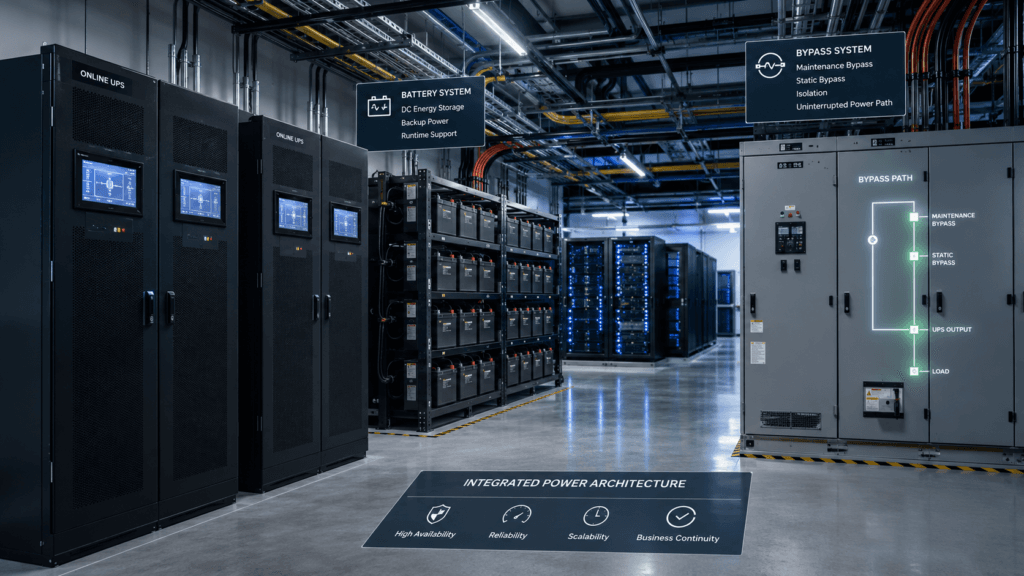
However, in critical environments, topology alone is not enough. A UPS must also be designed with a proper bypass path, maintenance strategy, and failure scenario in mind.
A UPS is not only about how it operates during normal conditions.
It is also about what happens when something goes wrong.
Three Common UPS Topologies
UPS systems are commonly discussed in three basic topologies:
- Standby, also called offline UPS
- Line-interactive UPS
- Online double-conversion UPS
Each topology provides a different level of protection, complexity, efficiency, and cost.
The important point is not to say one topology is always right.
The important point is to match the UPS design with the sensitivity of the load and the risk level of the facility.
Standby UPS: Simple Backup for Less Critical Loads
A standby UPS normally allows the load to be supplied by utility power.
When utility power fails or moves outside a certain range, the UPS transfers the load to battery-supported inverter output.
This type of UPS is simple and cost-effective.
It may be suitable for small office equipment, personal computers, small network devices, or less critical applications.
But it has a limitation.
There is a transfer event.
For many ordinary loads, this short transfer may be acceptable. But for critical environments, the tolerance for interruption is much lower.
That is why standby UPS is usually not the preferred choice for mission-critical power architecture.
Line-Interactive UPS: Better Protection, Still Limited
A line-interactive UPS improves on the standby concept.
It can regulate some voltage variations without immediately switching to battery operation. This makes it useful in environments where voltage fluctuation is common but the load does not require the highest level of power conditioning.
Line-interactive UPS systems are often used for small servers, network closets, telecom equipment, or branch office IT systems.
They provide more protection than a basic standby UPS.
However, they are still not the same as a full online double-conversion UPS.
For highly sensitive loads, critical IT infrastructure, or facilities where continuous power quality is required, line-interactive topology may not be enough.
Online Double-Conversion UPS: The Critical Environment Standard
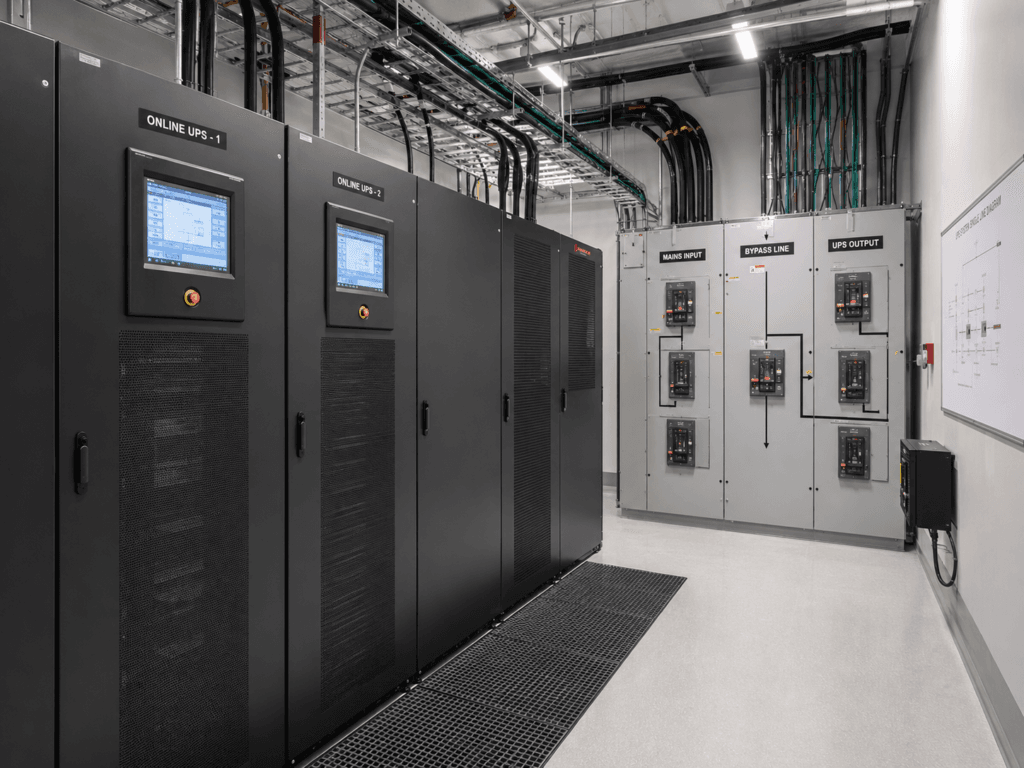
In an online double-conversion UPS, incoming AC power is converted to DC and then converted back to AC.
This means the load is normally supplied through the inverter.
The critical load is not simply waiting for a transfer event. It is continuously supplied by conditioned power from the UPS system.
This structure provides strong protection against many upstream disturbances, including voltage variation, frequency instability, and short interruptions.
That is why online double-conversion UPS systems are commonly associated with data centers, industrial control systems, healthcare facilities, telecom infrastructure, and other mission-critical environments.
Of course, this does not mean online UPS is perfect.
It is more complex.
It generates heat.
It requires maintenance.
It depends on batteries or other energy storage systems.
It needs proper bypass and protection coordination.
But for critical environments, it provides a level of power continuity that simpler UPS topologies cannot provide.
Static UPS and Rotary UPS
Another way to discuss UPS systems is by looking at the technology used to deliver backup and conditioned power.
Most people are familiar with static UPS systems. These use power electronics such as rectifiers, inverters, static switches, and batteries.
Rotary UPS systems use rotating machines, such as motor-generator sets, flywheels, or hybrid arrangements.
Static UPS systems are widely used and modular.
Rotary UPS systems can be attractive in certain large-scale or specialized applications.
This article will not go deeply into static versus rotary UPS design. That can become a separate topic.
For now, the key point is simple:
UPS topology is not just a product label.
It defines how the critical load is supported during normal operation, disturbance, transfer, failure, and maintenance.
Topology Alone Does Not Create Availability
A common mistake is to focus only on UPS type.
For example:
“We installed an online UPS, so the load is protected.”
That may be true in a narrow sense.
But critical power reliability depends on the complete system, not only the UPS module.
What happens if the UPS inverter fails?
What happens if the UPS is overloaded?
What happens if the battery string has degraded?
What happens during preventive maintenance?
What happens if a breaker trips upstream or downstream?
Can the UPS be isolated safely?
Can the load remain energized during UPS service?
These questions lead to one of the most important parts of UPS design:
Bypass.
What Is a UPS Bypass?
A bypass path allows the load to be supplied through an alternate path instead of the normal UPS inverter path.
This is essential because the UPS itself is also equipment.
And every piece of equipment needs a maintenance strategy.
In general, there are two major bypass concepts:
- Static bypass
- Maintenance bypass
A static bypass is typically an automatic path inside the UPS system. If the inverter cannot support the load due to overload, internal fault, or abnormal condition, the static bypass can transfer the load to an alternate source.
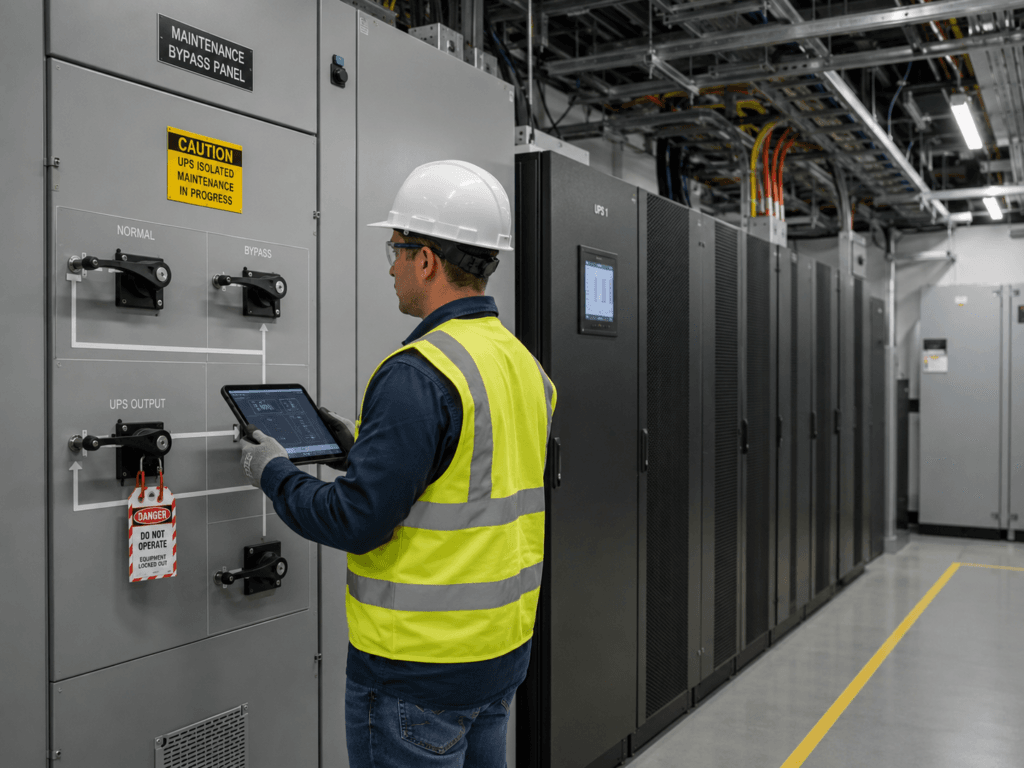
A maintenance bypass is usually a manual or engineered path that allows the UPS to be isolated for maintenance, testing, repair, or replacement while the load remains powered.
This is where the engineering mindset changes.
A bypass is not just an accessory.
It is part of the availability design.
Bypass Protects Continuity, But It Changes Risk
Bypass is necessary, but it is not magic.
When the load is transferred to bypass, the load may no longer be protected by the UPS inverter in the same way.
That means the system may maintain power continuity, but the load may become more exposed to upstream power quality issues.
This is an important operational point.
Bypass mode should not be treated casually.
Operators and maintenance teams should understand:
Why the UPS is on bypass
Whether the bypass source is stable
How long the system can remain in bypass
What protection is still active
What alarms should be monitored
How the system will return to normal operation
In critical environments, the bypass path should be designed, labeled, tested, and understood.
A bypass that no one understands can become a hidden risk.
Maintenance Bypass Is a Design Requirement
UPS maintenance is not optional.
Batteries age.
Fans fail.
Capacitors degrade.
Filters become dirty.
Power electronics need inspection.
Firmware or control systems may require updates.
Thermal conditions must be checked.
If the only way to maintain the UPS is to shut down the critical load, the system has a design problem.
A proper maintenance bypass allows technicians to work on the UPS while the protected load remains energized.
This does not remove all risk.
But it creates a controlled method for maintenance.
In critical facilities, maintainability is part of reliability.
A system that cannot be safely maintained will eventually become unreliable.
Field-Oriented Questions for UPS Bypass Design
From a field engineering perspective, UPS bypass design should be reviewed with practical questions.
Is the bypass path clearly shown on the single-line diagram?
Is the bypass source the same as the UPS input source or a separate source?
Are the bypass breakers clearly labeled?
Can the UPS be isolated without interrupting the load?
Is there a risk of backfeed?
Are interlocks required?
Are operating procedures available?
Has the transfer to bypass been tested?
Are operators trained to understand bypass alarms?
What happens if the facility is already on generator power?
What happens if bypass is used during unstable utility conditions?
These questions are not theoretical.
They are the kinds of questions that prevent mistakes during real maintenance work.
Closing
UPS topology matters.
A standby UPS, line-interactive UPS, and online double-conversion UPS do not provide the same level of protection.
For critical environments, online double-conversion UPS systems are often preferred because they provide continuous conditioned power to sensitive loads.
But topology is only the beginning.
A critical UPS system must also include a proper bypass strategy.
Because the real test of critical power design is not only normal operation.
It is failure, maintenance, transfer, and recovery.
A UPS should protect the load.
But the UPS itself must also be safely maintained, isolated, bypassed, and returned to service.
That is why UPS topology and bypass design must be considered together.
In the next article, we will zoom out and look at the broader critical power architecture for data centers.